Marriage allowance
The marriage allowance (also known as the transferable tax allowance for married couples and civil partners) allows you to give up some of your personal allowance to provide an amount (a tax credit) that can reduce the amount of income tax that your spouse or civil partner pays.
Content on this page:
Marriage allowance
The marriage allowance works by reducing the personal allowance of the donor spouse or civil partner, and providing a tax reducer (tax credit) to the spouse or civil partner who receives it, reducing their tax bill. It is not strictly an allowance in the hands of the person who receives it.
The marriage allowance is also known as the transferable tax allowance for married couples and civil partners. It should not be confused with the married couple’s allowance.
The marriage allowance for 2026/27 is £1,260.
This means that the donor spouse/partner gives up £1,260 of their personal allowance and the recipient spouse/partner receives a tax reducer (tax credit) of £252.
The maximum tax saving you can get as a couple from the marriage allowance is £252 for the 2026/27 tax year.
The recipient spouse/partner can set the tax reducer against their tax liability. If the tax reducer is greater than their tax liability, they will not receive a tax refund, nor will the donor spouse have their personal allowance readjusted.
The ‘mechanics’ of the marriage allowance can be illustrated as follows:
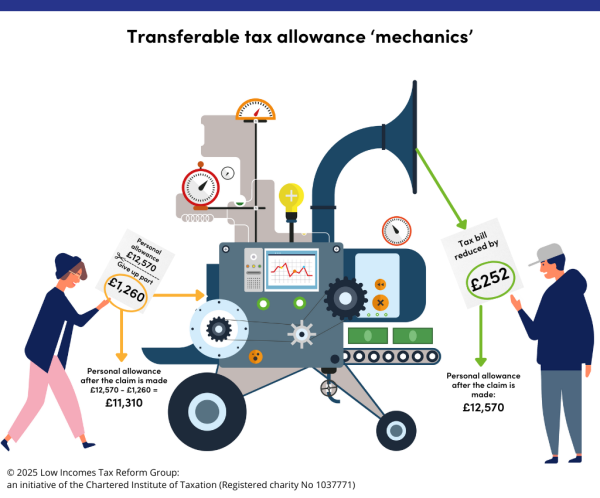
Note that if the recipient spouse or civil partner is in employment or receives pension income (other than the state pension) their PAYE code may be amended as if they received an extra £1,260 (for 2026/27) of allowances. This is indicated by the addition of an ‘M’ to the tax code. Similarly, the individual giving up part of their allowance should have an ‘N’ after their primary tax code (if they have one).
Eligibility
You can only claim the marriage allowance if both you and your spouse or civil partner meet certain conditions.
All of the following conditions must apply:
- You must be married or in a civil partnership (for more information on this, see the heading below: Changes in marriage or civil partnership status)
- You do not pay income tax at a rate higher than the basic rate (or higher than the intermediate rate if you are a Scottish taxpayer)
- Your partner does not pay income tax at a rate higher than the basic rate (or higher than the intermediate rate if they are a Scottish taxpayer)
When calculating the highest tax rate at which either spouse/partner is liable, you should ignore the personal savings allowance and/or dividend allowance and consider whether the savings and/or dividend income would be liable to the higher rate (40%) or dividend upper rate (35.75%) were it not for those allowances.
Timing of claims
If you make the claim during the tax year for which you are claiming (so after 5 April 2026 and before 6 April 2027 for the tax year 2026/27), the claim continues until either you withdraw it or the recipient spouse or civil partner does not obtain a tax advantage.
On the other hand, if you make the claim after the end of the relevant tax year, it will only have effect for the tax year to which the claim relates. So, if you make a claim after 5 April 2027 for 2026/27, you would need to make another claim for 2027/28 if appropriate.
The claim can be made up to four years after the end of the relevant tax year. For example, a claim for marriage allowance for the tax year 2026/27 must be made by 5 April 2031.
The first year that the marriage allowance could be claimed was 2015/16. Any claims for that year had to be made by 5 April 2020. From 6 April 2026, claims for the 2016/17, 2017/18, 2018/19, 2019/20, 2020/21 and 2021/22 tax years are also out of time. You can read more about claiming a marriage allowance tax refund for previous years on our page Marriage allowance tax refunds.
It is possible to make a claim even if one of the parties to the marriage or civil partnership is no longer alive – for more information, see our page Death of a spouse or civil partner.
When a claim for marriage allowance might not be beneficial
if you decide to claim the marriage allowance you must claim all of it (£1,260 in 2026/27). In some cases, this could leave you both worse off overall.
A marriage allowance claim may not be beneficial in the following circumstances:
- The income of the donor spouse or civil partner is more than 90% of the personal allowance (that is, more than £11,310 in 2026/27) and
- The income of the recipient spouse or civil partner is less than 110% of the personal allowance (that is, less than £13,830 in 2026/27).
You can see how this can happen in the example below.
If your incomes are variable, it may be better to wait until you are certain that a claim will be beneficial before making the claim.
If the recipient spouse or civil partner files a self assessment tax return for the year it applies, you should try to ensure that HMRC have a record of the donor having made the claim before that return is submitted. This is so that HMRC do not automatically adjust the tax calculation to remove the tax credit. If both the spouses or civil partners file self assessment tax returns, the donor should therefore submit their tax return first if possible.
If you are considering if to make a claim and when, you might find it helpful to look at our flowchart for couples that do not have a marriage allowance claim in place:
Marriage allowance flowchart for married couples / civil partnerships that do not have a marriage allowance claim in place by LITRG.
Withdrawing a claim
If you wish to withdraw a marriage allowance claim (for example, because it is no longer beneficial) you should note that only the individual who originally made the claim (by allowing their personal allowance to be reduced) may withdraw the claim. The withdrawal of the claim then only takes place from the start of the following tax year (but see Changes in marriage or civil partnership status below for an exception).
If you are considering withdrawing your marriage allowance claim, you may find it helpful to look at our flowchart for couples who have a marriage allowance claim in place:
Marriage allowance claim withdrawal flowchart for married couples / civil partnerships that have a marriage allowance claim in place by LITRG
Changes in marriage or civil partnership status
To claim marriage allowance for a given tax year, you need to be married to, or in a civil partnership with, the same person (that is, the person who will be receiving the allowance):
- for the whole or part of the tax year concerned, and
- at the point you make the claim (or if the claim is made after the death of one or both of the parties, then when they were both last living).
The marriage allowance is therefore available in full, if the other conditions are met (see above), for the year in which a marriage or civil partnership takes place.
Similarly, if you separate from your spouse or civil partner in a tax year, the marriage allowance is still available in full for that year if the other conditions are met (see above), but the claim must have been made prior to the separation. A claim remains in place in the tax year of the end of the marriage or civil partnership, unless the person giving up part of their allowance revokes their claim.
The marriage allowance is not available for any tax year after your marriage has ended (by divorce) or your civil partnership has been dissolved.
It is not possible to claim the marriage allowance after you are divorced or your civil partnership is dissolved, even if the claim would be for a time when you were still married or in a civil partnership.
For the purposes of marriage allowance, a marriage comes to an end if any of the following is made:
- final order/ decree absolute of divorce (decree of divorce in Scotland)
- decree of nullity (declarator of nullity in Scotland)
- judicial separation order/ decree of judicial separation (decree of separation in Scotland)
A civil partnership comes to an end if any of the following is made:
- dissolution order or nullity order, which has been made final (decree of dissolution or a declarator of nullity in Scotland)
- separation order (decree of separation in Scotland)
If you withdraw a claim, it usually has effect for the tax year after the one in which you gave the notice (see above under the heading: Withdrawing a claim). However, if the marriage or civil partnership comes to an end during the year in which you withdraw the claim, the marriage allowance is withdrawn for that year. So, if you withdraw the claim in August 2026 and the marriage or civil partnership comes to an end during the tax year 2026/27, then the allowance will not be available for 2026/27.
Claiming marriage allowance
You can apply for marriage allowance online on GOV.UK. If you cannot claim online, you can telephone HMRC to make the claim, or download form MATCF to make the claim.
More information
HMRC have guidance on marriage allowance on GOV.UK.
HMRC also have guidance on how to cancel or withdraw a claim for marriage allowance on GOV.UK.