Gig economy
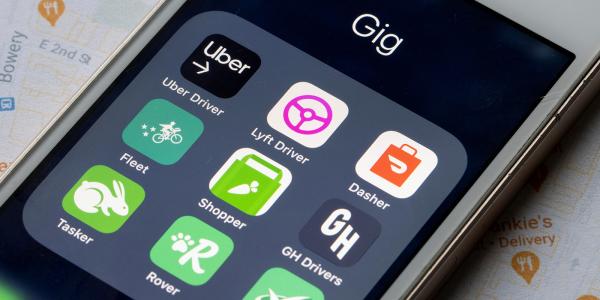
The ‘gig’ economy is tempting more people to earn extra cash by using one of the many available online platforms to offer rides, run errands, make deliveries, be an influencer on social media or do something else. This is a relatively new area of the economy and there are some important tax issues to be aware of.
Content on this page:
Overview
The starting point is that the income derived from such jobs is usually taxable (unless the total gross trading and miscellaneous income is £1,000 or less, in which case it may not be, as explained in the Trading allowance section below) – even if you receive payment in cash or do it as a ‘side job/hustle’. It gets more complicated when you factor in other matters like deductible expenses, tax allowances, record-keeping requirements and National Insurance contributions. This page, together with the pages below, explain the main things you need to know:
- online traders and using platforms,
- digital platform reporting rules
- seller information statements
- social media influencers, and
- gig work – what to do if you are behind on your taxes.
Trading income
You need to consider whether the income you earn is from self-employment. If your activity is regular, done with a view to generating a profit and continues for at least a few months, then this will mean you will likely be treated as ‘trading’ and thus, self-employed. Income from one-off jobs or very casual work may be taxable as miscellaneous income rather than self-employment income (as explained under the heading Miscellaneous income below). All the facts and circumstances will need to be considered when deciding the nature of the income. We look at this in more detail on our page Employed, self-employed or neither.
When you start earning, you need to keep records of all the income. Keeping good, accurate business records from the start is important, as it makes it easier to complete your tax return and it is a legal requirement if you are self-employed. You don’t need to open a new bank account for your gig work, but you may prefer to so that your self-employment finances are kept separate from your personal ones. An app might be able to help you with record keeping.
We explain more about apps in our recent news article about what to check if you use an app to track expenses when self-employed, which is linked to in ‘You might also like’ below.
You don’t need to keep records of your expenses if you think you will claim the trading allowance (see the heading Trading allowance below) but it is recommended that you do so in case you want to claim for your actual expenses instead of the trading allowance.
If you do not keep adequate business records, you may have to pay a penalty.
Tax and National Insurance contributions for self-employed gig workers
People who have self-employment income are responsible for reporting their income and paying their own tax and National Insurance contributions to HM Revenue & Customs (HMRC), via the completion of a self assessment tax return or by using Making Tax Digital for income tax.
A tax return is a legal document and a statement of all your taxable income and gains. It is important not to leave out any taxable income (unless it is fully covered by the trading allowance as explained under the heading Trading allowance below), no matter how small and whether tax has already been paid on it – for example, pay as you earn (PAYE) tax on employment or pension income. The self assessment tax return form has a section for self-employment income and expenses (explained in more detail under the heading Expenses below).
Under self assessment you can complete your tax return online and, if you do, you usually have to submit it and pay anything that you owe to HMRC by 31 January following the end of the tax year to which it relates. You can choose to complete a paper tax return, but this must be submitted to HMRC earlier. See our Tax return deadlines page for more details.
From your second year of trading, HMRC may ask you to make payments on account. These are estimates of what your tax bill will be at the end of the tax year, based on the previous tax year’s tax return – be sure to set aside enough money to pay them (if you need to).
If you do not complete your tax return correctly or submit it on time you may have to pay a penalty.
If you have self-employment income, it is usually necessary to complete a tax return even where your total level of income means that there is no tax or National Insurance contributions due (unless all your self-employment income is fully covered by the trading allowance). You can find the thresholds for tax and National Insurance contributions (NIC) on our Tax and NIC rates and bands page.
If you are self-employed then you may need to pay Class 4 National Insurance contributions or you may choose to pay Class 2 National Insurance contributions voluntarily. We cover when you may need to pay Class 4 National Insurance contributions and why you may want to pay Class 2 National Insurance contributions voluntarily, on our page National Insurance for the self-employed.
Registering as self-employed
We cover how and when to register in detail on our page, Self-employment: registering for tax and National Insurance contributions.
If you have not registered for self assessment before then once you have registered, HMRC will send you a Unique Taxpayer Reference (UTR) which is your reference for the tax return system. If you are going to complete your self assessment tax return online, you will also need log-in details so that you can access HMRC’s online services system.
We also explain what to do if you are already in the self assessment system but aren’t registered as self-employed on our page Self-employment: registering for tax and NIC.
New line of work?
If you are already in the self assessment system and are already registered as self-employed but in a different trade sector to your gig work (for example, you are a builder but start driving for Uber in the evenings), you do not need to register your self-employment again, but when you complete your self assessment tax return, you will need to state you have two different trades (by completing two sets of self-employment pages/sections) and include details for each trade separately. We cover this in the section below Filling in your self assessment tax return. For more information see our guidance on having more than one self-employment trade (sometimes called multiple trades).
If you are already self-employed and using Making Tax Digital to report that income, then you will need to keep separate digital records and submit separate quarterly updates for your gig work, see our guidance on Record keeping and quarterly updates for Making Tax Digital.
You may not need to tell HMRC about your gig economy income if it is fully covered by the trading allowance, as explained under the heading Trading allowance below.
Deadlines
Our page Registering for self assessment explains the registration deadlines and what to do if you miss the notification deadline.
Calculating tax on gig economy profits
On our calculating self-employed profits page, we cover this in more detail for general self-employment businesses. Although the tax rules are the same, below are examples of how profits are calculated for gig workers.
You only pay tax and class 4 National Insurance contributions on your ‘profit’ – so if your income is £5,000 a year and you have £1,200 of business expenses (as explained under the heading Expenses below), you would only pay tax on your profit of £3,800.
The amount of tax you pay on your profit depends on what other taxable income you have, as shown in the example below.
Usually, tax and National Insurance contributions are calculated for you automatically as part of completing your online self-assessment tax return or end of year tax return under Making Tax Digital, but it is useful to understand how it works. The detailed example of Colin below shows how tax and National Insurance contributions is calculated using 2025/26 tax rates (the 2025/26 tax return is due by 31 January 2027).
There is more detailed information about calculating what tax is due on our page ‘Working out your tax’.
Losses
It may be the case that instead of making a profit you make a loss. To make a loss you must have more allowable business expenses than income earned through your self-employment. This would be quite unusual in gig economy work where you are essentially making money from your time rather than, for example, buying stock to sell or having a big outlay such as rent on business premises or equipment.
Our Trading losses page explains the various ways you can get tax relief for a loss depending on your circumstances such as:
- Have you just started or are finishing your gig work?
- Do you have other taxable income in the tax year?
Expenses
When calculating your profit, you can deduct any expenses ‘wholly and exclusively’ paid out for the purposes of your business. This might include expenses such as car, van or other travel expenses and administrative costs, including mobile phones.
On our Business expenses: allowable for tax page we cover various expenses in more detail for general self-employment trades. Some of this guidance will be relevant for gig economy workers. Also our Calculating self-employed profits page covers business expenses including examples on what you can claim if you use something for both business and private purposes, like a mobile phone or vehicle.
As explained under the heading Trading allowance below, you may be able to claim a round sum amount equal to the ‘trading allowance’ for your business expenses instead of the actual business expenses you have incurred.
Double counting expenses
For many people working in the gig economy, some of your income might be paid to you after certain costs have already been deducted, such as online platform fees and selling commissions.
It is important not to count these expenses twice by mistake as this will understate your taxable profits and could mean you pay too little tax and National Insurance contributions. For example, if you have an expense, such as platform fees, which is taken off your income before it is transferred into your bank account, and you take this ‘net’ amount as income but then also deduct the platform fees again as a separate expense (or use the trading allowance), then you will have double counted these expenses.
To make sure your figures are accurate when dealing with these types of expenses, you need to make sure you add the expense back on to the amount you have received in your bank account and then deduct the expense separately.
Vehicle expenses
There are two approaches to calculating business expenses relating to vehicles. You can either use the simplified mileage rates or claim a business proportion of actual costs and /or capital allowances. You can’t claim both.
We cover in detail the two approaches to calculating vehicle expenses on our Business expenses: allowable for tax page.
You need to be careful not to count ‘ordinary commuting’ as business mileage. For example, if you are a courier and travel regularly to a depot to take instructions or collect parcels before you go out on your rounds, HMRC are likely to class the journey from your home to the depot as ordinary commuting.
Other expenses
Most expenses that you incur doing your gig work should be allowed. Some common expenses gig workers might have include:
- insurance
- PayPal or banking charges
- uniforms
- internet
Expenses which are not allowed include entertaining, most subsistence costs (such as lunches when you are at work) and clothing (unless it’s something you only use for work – for example, specific reflective clothing for cycling at night which you only use when delivering takeaways).
If you have purchased a capital asset to use in your business (such as a vehicle or IT equipment) then how you treat this for tax purposes depends on whether you are using the cash basis or traditional accounting (accruals basis) to work out your figures. Our page Business expenses: capital and capital allowances explains how you get tax relief for capital expenditure if you claim capital allowances.
Filling out your self assessment tax return
Filling out a self assessment tax return for the first time can be daunting, but the good news is that most of the boxes on the tax return will not be relevant to you and if you use HMRC’s online version of the self assessment tax return the tailored questions section will reduce the number you do need to complete.
You will need to work through the main section of the form (with your personal details, etc.) and then fill in the supplementary self-employment pages/section to report your gig work, together with any other supplementary pages/sections that may be relevant. If you are also employed, you will need to fill in the supplementary employment pages/section too, even though tax has already been paid at source under PAYE.
Most people doing gig work use what is known as the cash basis to work out the figures for their tax return (where income received less what was spent is your taxable profit) rather than traditional accounting (accruals basis), where sometimes income or expenses are taken into account before or after they actually occur (they are ‘matched’ to the accounting period they relate to rather than when they are actually received/paid for). For the 2024/25 tax year onwards the cash basis is the default method to work out your profit from self-employment/gig work, but you can elect to use the accruals basis instead.
Working for more than one platform
Many people working in the gig economy provide services for different platforms at the same time – for example, offering delivery services for a number of different delivery apps. When preparing your tax return, it is important to include income from all the different self-employment platforms and be careful to only deduct expenses once if they relate to more than one income stream (such as different apps). For example, if you are a delivery driver and your bike needs repairing then that cost should only be deducted once in total even if you deliver for several different delivery apps.
If the type of work that you do for the platforms is similar, then you only need to fill out one set of self-employment pages for all the different income streams. However, if you have two or more distinct trades, such as selling home-made cards and delivering via platforms then two different sets of self-employment pages/sections will be needed to report the figures.
End of year tax returns under Making Tax Digital
Some people with income from self-employment and/or property income will have to use Making Tax Digital for income tax to report their tax information to HMRC instead of filling in a self assessment tax return. There is information on our Making Tax Digital section explaining who will need to use this new tax reporting system, when you will need to use it and what you need to do to be ready for it.
Stopping self-employment
We cover what to do when you cease self-employment on our Self-employment: stopping your business page.
Miscellaneous income
‘Miscellaneous’ catches taxable income which does not fall within any other category, such as employment or self-employment.
You will need to tell HMRC about any miscellaneous income payments (unless they fall under the trading allowance – see the Trading allowance heading below), but you may not need to complete a tax return if there is no tax due or HMRC are able to collect any tax owed another way – for example, by adjusting your PAYE tax code (if you have one).
If the income is ‘miscellaneous’, you cannot pay Class 2 National Insurance contributions. Unless enough National Insurance contributions or National Insurance credits will be put on your record any other way, you may wish to consider making voluntary Class 3 National Insurance contributions. These are quite expensive at £18.40 a week (in 2026/27), so before committing yourself, you should consider if it is necessary to make them, taking account of how many qualifying years you have already towards your state pension and your future potential to make up any gaps. You can check how many qualifying years you have already through your Personal Tax Account and you can usually pay Class 3 National Insurance contributions within six tax years. For more information on the different classes of National Insurance contributions and what contributions pay for, see our National Insurance page.
Trading allowance
A trading allowance was introduced to exempt gross trading and/or miscellaneous income of up to £1,000 per tax year from income tax. This might include income from the gig economy or from selling online.
There is detailed guidance and examples on our Trading allowance page, but in summary if your total trading income from all sources and/or miscellaneous income (before expenses) is £1,000 or less then you have no taxable income from the activities. This means there is no need to include the income on a tax return (referred to as full relief).
Partial relief of the trading allowance is also illustrated in the example of Sarah on our Trading allowance page.
It will still be necessary to keep accurate business records for your trading income and could be very helpful to do so for your expenses so you are to be able to work out whether or not you wish to claim partial relief trading allowance.
There may be some occasions when it is preferable for you to report your gig economy income to HMRC even if it is fully covered by the trading allowance. It is also important to understand that you still need to report the income covered by the trading allowance for some means-tested benefits, such as universal credit. There is more explanation on our Trading allowance page.
Remember that some of your income might be paid to you after certain costs have already been deducted, such as platform fees and commissions, so you must be careful how you use the trading allowance. There is an illustration of this in the example of Gabby on our Trading allowance page.
If you have claimed the trading allowance incorrectly, perhaps by using full relief when your gross income is actually above £1,000, then you need to make sure you correct your tax position as soon as possible. We explain what to do in detail in this situation under the heading, Incorrectly claimed the trading allowance on our Trading allowance page.
Working through a limited company
You may have heard about supplying your services through your own limited company as a way of saving some tax. Setting up a limited company is very different from just being ‘self-employed’ or a ‘sole trader’ in your own name.
Our Limited companies page explains what a limited company is, how it is taxed and what you need to be aware of if you work through a company. Generally, a company may not be a suitable way to trade for those on relatively low incomes because of all the administrative considerations.
VAT
VAT (Value Added Tax) is a type of sales tax added to the price of most goods and services in the UK by VAT registered businesses. VAT is not additional income for the business, it is money they collect from the customer and pay to HMRC. So, for example, if you are a VAT-registered delivery driver, and you earn £125 a day, then you will actually need to collect the amount of £150 (that is £125 + VAT of £25) but you should remember that you will need to pay some or all of the ‘extra’ £25 to HMRC.
We explain more about how VAT works on our page Value-added tax and cover when you need to register for VAT on our VAT when running a business page.
Most gig workers, in business on their own account, will have total sales income well below the VAT registration threshold (£90,000 for 2026/27) and are therefore not required to register for VAT. If you are not registered for VAT, it means that:
- you do not charge VAT on your supplies to your customers (output tax)
- you cannot reclaim the VAT paid on your expenses (input tax).
Relief for expenses if not VAT registered
Even though you cannot reclaim input tax when you are not VAT registered, you get full tax relief for your VAT inclusive business costs by claiming the total amount you have paid as a business expense in your self-employed accounts for income tax and National Insurance purposes.
Some people in the gig economy with income under the VAT threshold choose to register for VAT ‘voluntarily’ – usually to get some extra relief for their expenses. However, as we set out in our VAT when running a business page, entering the VAT regime is not something to be undertaken lightly as the costs and extra administration can easily outweigh any benefits.
Employment rights
Gig economy workers have traditionally been classified as self-employed for employment law purposes. A ‘genuinely’ self-employed person is their own boss and so needs no protection under employment law. But this view has been challenged recently by individuals claiming they should be reclassified as ‘workers’ for employment law purposes, meaning that they are entitled to a core set of rights and protections including the minimum wage and paid holidays. For more information see our page on employment rights.
Benefits
Universal credit has replaced tax credits as the main ‘in work’ benefit.
Under universal credit you do not need to work a set number of hours like you did for tax credits, but there is a ‘gainful self-employment test’ and if you are not ‘gainfully self-employed’, you are likely to have some work-related obligations as part of your claim (unless you are formally deemed to have no work requirements).
Our section on Self-employment and universal credit, explains what information the Department for Work and Pensions (DWP) will look at when considering if you are gainfully self-employed. If the DWP decide you are gainfully self-employed, you should be aware that the Minimum Income Floor (MIF) may apply after 12 months of starting self-employment, meaning that universal credit payments will be made based on an assumption that you are earning a certain amount from your self-employment (even if that is not the case, for example because of unexpected fluctuations in income and expenses).
Universal credit is a monthly benefit, calculated and paid in arrears, which means that the amount you get is worked out on your circumstances and the income you have received in your ‘assessment period’. Our Self-employment and universal credit section explains how your monthly profits will be calculated by the DWP for each assessment period. You should be careful not to confuse HMRC with the DWP and in particular, be aware that the rules for calculating relevant profit figures for universal credit are not exactly the same as the rules for tax purposes. For example, the trading allowance (mentioned under the heading, Trading allowance above) is not recognised for universal credit purposes.
There is also information about universal credit and self-employment on GOV.UK.
Losing your job
The usual benefit that people think of if they are unemployed is ‘New style’ Jobseekers Allowance. This is a contributory benefit (and so entitlement is based on whether you have paid enough National Insurance contributions), but it is not available to formerly self-employed people who are now unemployed.
The main benefit you may be able to claim if you are no longer working and are struggling to find work is universal credit. For those who have reached their state pension qualifying age, it is pension credit. If you get universal credit as you are out of work but then find some more work, you may be able to continue to claim universal credit, depending on how much you are earning. There is no upper limit to the number of hours you can work, although your earnings will usually reduce the amount of your award and sometimes they will reduce it to nil.
For information on claiming benefits if you are behind with your taxes, see our page on Gig work- what to do if you are behind on your taxes.
More information
There is more detailed guidance on self-employment generally on our website and GOV.UK.
We have guidance on our website on being a social media influencer.
To understand what help is available with completing a tax return, see the guidance in our Help with tax page. This might be from a professional adviser, the tax charities, an app, or even HMRC. If you want to try and do it yourself, then that’s fine too and we have lots of information to help you on our website and we have a case study in our self-employment guide which covers the self-employment pages on the tax return.
If you are working in the gig economy and are behind with your taxes then we look at how to bring your tax affairs up to date on our dedicated page Gig work – what to do if you are behind on your taxes.
There is ‘Help for hustles’ guidance on GOV.UK.
If you require more detailed information on miscellaneous income, you could look at HMRC’s manual.
You can find out more about universal credit and self-employment on our website and on GOV.UK.
Making Tax Digital for Income Tax is a new way of recording and reporting your tax information to HMRC. It affects individuals with self-employment and/or property income and you may be required to use it from April 2026. For more information on Making Tax Digital see our detailed guidance.