Elective Deduction Model
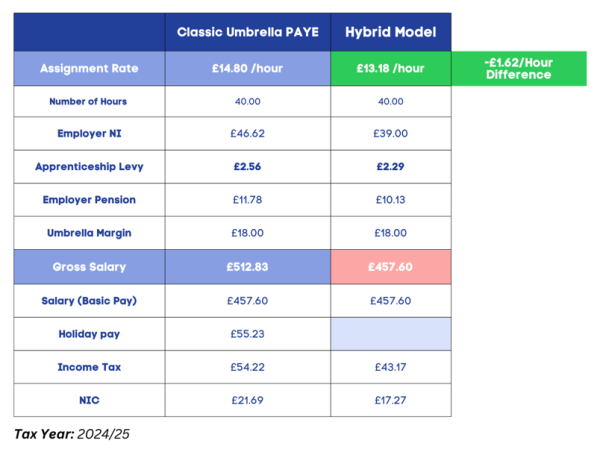
The elective deduction model – sometimes called the hybrid model - is where you are treated as employed for tax purposes (so that PAYE is operated) but self-employed for employment law purposes so that you do not get certain employment law rights.

Content on this page:
These models are becoming increasingly common. Here, we consider the model mainly in the context of lower-paid agency workers working through umbrella companies, but it is worth saying that agency workers who work directly through agencies can also find themselves in such models.
Background to the model
This model exploits some of the complexities around employment status. Employment status matters because it affects:
- what rights individuals have at work (such as holiday pay), and
- how they pay tax.
The law allows for employment status to be assessed differently for tax and employment rights. In practice, however, the position for most agency workers is usually clear:
- For employment rights, they will normally have at least worker status, and often employee status if they are employed by an umbrella company
- Under the agency legislation, they usually need to be treated as an employee for tax purposes with PAYE operated by either the agency or umbrella company
In the elective deduction model, however, companies treat individuals as self-employed for employment rights, while still treating them as employees for tax purposes.
In reality, it is very unlikely that an agency worker is genuinely self-employed for employment law purposes. Regardless of what a contract says, most agency workers work under someone else’s direction or control, and are not running a business on their own account.
Because of this, the elective deduction model can amount to a form of false self-employment, where workers are denied rights in order to save costs.
What’s behind the increase in such arrangements?
This model helps umbrella companies save money on suppling labour – savings which are then shared through the labour supply chain.
The recent large rises to the National Minimum Wage appear to be a key driver. In sectors where there are more workers available than jobs, and where end clients can push down rates, there may not be enough money flowing through the supply chain to allow everyone involved to cover all the costs and obligations and still make their margin.
This is made worse because there isn’t strong enforcement of employment rights. Some low paid workers will not realise there is a problem, or they may not feel able to question it. With very little oversight of employment law status or holiday pay, there is nothing in place to help protect their position. As a result, these models are able to continue with almost no challenge.
HMRC’s position on the model
HMRC have recently held a webinar, where they stated their view that they do not think the elective deduction model is a legitimate model. This is because it is not possible to voluntarily withhold PAYE – either PAYE is due under law, or it isn’t. A recording of the webinar can be found on GOV.UK (see Labour supply chains featuring umbrella companies). This is important, as there is a connection with employment rights as explained below.
PAYE, control and employment rights – the connection
In line with HMRC’s position, if an entity in an agency worker supply chain is deducting PAYE, this should be because the worker meets the legal conditions for PAYE to apply. Under the agency legislation, one of the key conditions as set out in HMRC’s manual, is that the way the individual provides their services is subject to (or to a right of) supervision, direction, or control (SDC) by any person.
This concept is very closely linked to employment status more generally. Put simply – employees tend to work under a lot of control, whereas the self-employed do not. You can read more about this in HMRC’s manual.
Therefore, if you are under enough supervision, direction, or control for PAYE to apply, this may raise questions as to whether you can be treated as genuinely self-employed for employment law purposes.
Future changes to employment law and tax rules
The government department responsible for employment law, the Department for Business, Innovation, Science and Trade, is currently consulting on the regulation of agencies and umbrella companies. We expect models like the elective deduction model to be part of the discussion.
In terms of employment law more generally, the Fair Work Agency will be established from 6 April 2026. It will have responsibility for the state enforcement of holiday pay, although this function may not be fully operational until later. You can read more on the Acas website.
In the meantime, it may also be helpful to know that from April 2026, new HMRC rules will affect umbrella company supply chains. Under these rules, recruitment agencies (or, where there is no agency, end clients) will be jointly and severally liable for PAYE amounts that should have been accounted for on payments to workers supplied through umbrella companies. You can read more about the new rules in our umbrella company guidance.
Although PAYE is deducted in elective deduction models, it may be understated because workers may not be getting all the taxable pay they are entitled to. This means there can still be a tax loss in the supply chain, albeit an indirect one.
The new rules technically only come into play when someone is ‘employed’ by an umbrella company, which is, of course, a problem under the elective deduction model. However, the ’purported umbrella’ rules (which are intended to address specific types of avoidance) mean that the joint and several liability may well apply in supply chains where umbrella companies are using self-employed-type arrangements.
It remains to be seen whether HMRC can or will use the new rules to specifically create any pressure in supply chains to help tackle the elective deduction model. However, the new rules will inevitably improve due diligence by agencies and end clients as to the umbrella companies they use. In practice therefore, the rules should drive better practice across the board - hopefully meaning all types of unfair arrangements become less common.
More information if you think you are affected
You might be affected by this issue if:
- You receive a payslip and PAYE is deducted, but
- Your umbrella company says you are self-employed or not entitled to holiday pay‑employed or not entitled to holiday pay
- You are paid close to the National Minimum Wage
- Your contract uses terms like ‘self-employed’ or ‘contract for services’, but someone tells you when, where or how to do your job
If you think you may be in an elective deduction model:
- Keep copies of your contract, payslips, and any messages about your status
- Ask your umbrella company to explain why PAYE is deducted if you are said to be self-employed
- Seek further support - we have more guidance on employment status on our website, including what to do if you think you are in false self-employment and who can help – for example an enforcement body or Employment Tribunal.