
Where will people go for help now that the HMRC customer forums have closed?

HMRC’s customer online forums closed on the 30 June 2025, with HMRC suggesting people use other alternatives such as the digital assistant and webchat instead. Given issues with some of these alternatives, even more taxpayers are likely to turn to other forums or even AI like ChatGPT or Google’s Gemini with their tax questions. Here we explore a few of the main channels and offer taxpayers some vital points to consider when using other forums and AI tools.

Content on this page:
HMRC customer forums closed for new issues and for posts onto existing threads in early June. Historic content in the customer forums was available to view until 30 June but after this date, they completely closed.
The closure removes what was a valuable, if imperfect, support channel for unrepresented taxpayers. Indeed, for people who prefer getting help online rather than waiting on the phone, the closure could leave a significant gap. In this post, we explore the alternatives HMRC has suggested — and why some taxpayers may now be turning to other public forums or AI tools like ChatGPT and Google Gemini instead. We also offer a few key warnings for taxpayers to keep in mind when using them.
What were HMRC’s customer forums?
The forums were designed to provide answers to general tax queries, with some involvement from official HMRC administrators. While they didn’t offer personalised advice, they allowed people to post questions and learn from others in similar situations. In HMRC’s own words:
‘Our customer forums are here to help you find answers to common queries. As it’s a public forum, we cannot provide tailored advice on your specific circumstances. You’re welcome to ask general questions and search for answers to similar queries.
While we aim to respond to questions as quickly as possible, response times will vary depending on demand and the complexity of the query. For immediate assistance, please use HMRC’s digital assistant. You can find the link on our contact us pages.
All official responses on the forum will be from ‘HMRC Admin’. Please note that we’re not responsible for the accuracy of comments or answers provided by other forum members’.
Why did HMRC’s customer forums close?
HMRC said they were closing the forums in response to the increasing popularity of newer, superior digital support channels. You can find HMRC’s full statement in our previous news item.
Although some people may have found posting a question in the forums much easier and more convenient than other ways of contacting HMRC, the forums definitely had some flaws.
For instance, we observed instances where incorrect information appears to have been given by HMRC. Questions could often take a week or more to get respond to and there were hurdles to posting as an interested third party (as we attempted on various occasions but had our responses rejected by moderators).
In recent years, HMRC made some improvements to the forums in response to feedback given. For example, the introductory note relayed above was added at the top of the forum which explained the role of the forum and the basis on which information was provided/the limitations that there were.
In our view, with some more improvements, there was definitely a place for the online forums. The intention for them to be a searchable ‘library’ of answers to help other taxpayers was worthwhile. They were a useful source of both practical answers and evidence of recurring issues. It is a shame that HMRC chose to close the forums rather than to develop them further.
The replacements - digital assistant and webchat
HMRC has pointed to its digital assistant and webchat service as alternatives. Whilst both have the potential to provide valuable support, we have some concerns that they are currently falling short in some respects and neither can replace the ‘question bank’ role that the forums played for others looking for similar information.
HMRC’s digital assistant is a ‘chatbot’ that will provide links to GOV.UK guidance pages or provide other instructions in answer to the question asked. In its current format, it can only cope with very basic/very clearly formulated questions and seems extremely limited in scope with a set number of predefined responses. When we tested it recently, it struggled with several of the questions and only answered in a very reductive way for others. For instance, when we asked ‘I have just started a delivery job, how do I pay my taxes’ the response was ‘I do not understand what you want help with. Try using fewer words’. That’s unlikely to help someone new to the system.
Webchat, where you can exchange messages with an actual HMRC adviser, is more promising. In fact, HMRC say almost any task that can be actioned, or query that can be resolved on the phone, can also be dealt with via webchat, where available.
But it’s the ‘where available’ bit that is of concern. To access the webchat service, you first have to go to the relevant contact page on GOV.UK and then click ‘Ask HMRC online’ or something similar. This will take you to the digital assistant as the first line of support.
The ability to access webchat is not always obvious from the digital assistant as at the end of the chat you might only be given the option of ending the chat or asking another question. People may not realise that if the answer you get from the digital assistant is not helpful, you can ask to be transferred to an HMRC webchat adviser by typing ‘I’d like to speak to an adviser’ (or similar words) in the box. We would like to see HMRC urgently improve the digital assistant so that always tells people about the webchat option where it cannot answer the question.
Also, webchat availability changes throughout the day based on the availability of HMRC advisers. Sometimes no advisers are available, so you may have to try multiple times. If an adviser is available, you may need to wait in a queue. At the time of writing this, an income tax webchat adviser was available but the queue time was 27 minutes.
Where are people turning instead?
If people cannot get what they need, when they need it, from HMRC’s tools, some will head elsewhere.
For example, there are many ‘community’ forums like Money Saving Expert (MSE) or Reddit, where users can pose questions, share information or solicit advice including about tax matters, for free.
It can be an effective way to access and gather knowledge and responses to questions can be received quickly. If you are extremely lucky, your question could be picked up by someone with relevant expertise (for example, LITRG post on MSE).
In such spaces however, there is no control over the accuracy of the content and so individuals could easily be misled by incorrect information posted in good faith by another user. In this context, it is particularly vital to remember that tax is not regulated and anyone can call themselves an accountant!
Even where the information provided is correct, it could be context specific. There are also often multiple messages flying around and/or ‘information overload’. For people unfamiliar with what to look for, it could be hard to pick out the objective and reliable information in all of the user-generated content.
While online forums can offer valuable insights and support, it is essential to approach them with caution and understand the limitations.
An alternative – Large Language Model AI tools.
As AI grows, it is inevitable that tools like ChatGPT and Google’s Gemini will play an increasing role in supporting people with questions about tax.
Tools like these are large language models – basically they are trained on the huge amount of content available on the internet – books, websites, text, data etc. It doesn’t really ‘know’ things, but because it has read so much, it is very good at guessing the next word in a sentence based on the prompt and everything it has seen before in relation to the subject matter in the prompt.
We have tested ChatGPT fairly extensively and can see the appeal – it returns clean, uncluttered answers, in super-fast time. It is very good at generating human-like responses. The personalisation/conversational style makes it feel accessible and it invites follow up questions.
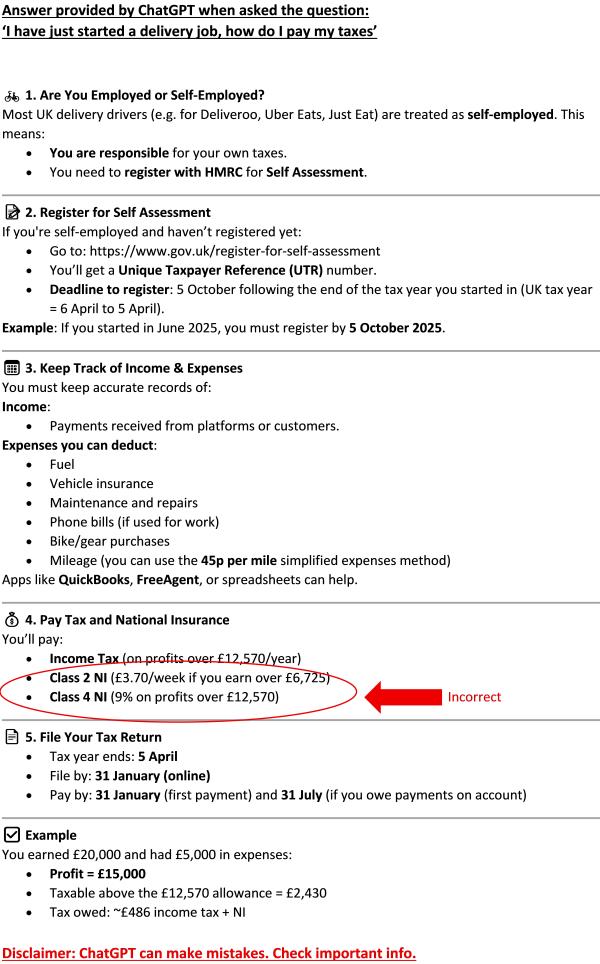
For example, to the delivery driver query above, the ChatGPT answer started:
‘Congrats on starting your delivery job! Here's a breakdown of how to pay your taxes depending on how you’re working’
The tool then gave a step by step guide, including a hint to think about employment status, information on how to register as self-employed including a link to the relevant GOV.UK page, an explanation about income and expenses, key deadlines and so on. It included a short example and some helpful tips, including about the availability of simplified expenses for mileage and how Apps might help.
However, some of output – despite looking highly plausible - was incorrect/outdated. For instance, it told us that we would have to pay Class 2 National Insurance at £3.70 per week if earnings were more than £6,725. This is:
- wrong - Class 2 NIC has never been £3.70
- no longer the case - £6,725 was the threshold in 2024/25.
And therein lies the problem. While tools like ChatGPT can offer quick answers in a nice way, relying solely on them poses significant risks.
Although we have illustrated the potential issues with an example from ChatGPT, there are many other large language models that give similar results. We are also seeing an increasing number of search results topped by results from Google’s own AI tool – Gemini.
When using any AI tools, it is crucial to understand that answers may be outdated – for example the free version of ChatGPT we were using in the query above is only up to date with UK tax rules and other information as of June 2024 - and in some instances, may be made up or ‘hallucinated’. The dangers of hallucination can be seen in the tax case of Felicity Harber v HMRC, where the appellant tried to rely on legal principles set down in previous tax cases which AI had made up.
AI tools may have particular limitations in terms of their ability to answer very specific or nuanced questions - tax can be extremely complex and AI may struggle to fully appreciate unique circumstances, leading to potentially incorrect or misleading answers.
It is also important to be aware of data issues – asking AI tools for help may involve sharing sensitive personal or financial information. Once you share information with an AI tool, it will retain it forever and it may use your information in various ways and replay it to other users.
To see the ChatGPT answer in full, including the incorrect NIC bits, view the image at the end of this article.
Final thoughts – use alternatives carefully and critically!
Despite their shortcomings, inevitably people are going to use online forums and AI tools more and more to help understand and manage their tax affairs. It is possible that the closure of HMRC’s customer forums will accelerate the take up of such alternatives, especially while HMRC’s digital assistant and webchat arguably fall short in availability, functionality and clarity. Community forums and AI tools can be very helpful but come with serious risks including misinformation, data privacy concerns, and a lack of tailored, up-to-date advice.
Our conclusion is that as the tax landscape becomes more complex, it’s vital that HMRC invests in more robust online support tools that are able to meet a full range of taxpayer needs.
In the meantime, our take-away for taxpayers is this: By all means use things like community forums and AI tools, such as ChatGPT and Google Gemini as a starting point – but know their limits. If you are told something about your tax, it is important to ‘double check’ what you are being told. We would usually recommend the LITRG website, where we produce a range of information and guidance. The HMRC pages on GOV.UK also offer a variety of tax information. For very complex queries, sometimes there can be no substitute for paid advice from a professional tax adviser. If you are on a low income and can’t afford one, help may be available via one of the tax charities. You can find more information on our Getting help page.



Comments
Add new comment