This is a news story and may not be up to date. You can find the date it was published above the title. Our Tax Guides feature the latest up-to-date tax information and guidance. 

Updated on 16 January 2026

Tax bill higher than you expected? Don’t forget payments on account!

News

Payments on account are advance payments towards next year’s tax bill. If this is the first time you need to make payments on account, they can be surprising – and a little confusing! In this article, we explain more about how payments on account work, and what you can do if you are worried about paying them.
an example of a tax bill with the words 'TAX BILL' in large white text against a red background
Canva.com

Content on this page:

If you are completing your 2024/25 self assessment tax return and the amount of tax you owe HMRC is more than £1,000, the calculation might show that you also need to make two payments on account for 2025/26, on top of your 2024/25 tax bill. Each payment on account is calculated as 50% of the income tax and class 4 National Insurance contributions (also known as NIC) payable under self assessment for 2024/25.

The first payment on account for 2025/26 is due on 31 January 2026, at the same time as your tax bill for 2024/25. If you are making payments on account for the first time, this will mean that you have to pay up to 1.5 times your tax bill for 2024/25 by 31 January 2026. This can be quite a shock to your cash flow!

The second payment on account for 2025/26 is due on 31 July 2026.

Who has to make payments on account?

Payments on account are usually due if the income tax (and class 4 National Insurance contributions, if applicable) you owe under self assessment is more than £1,000.

When looking at the £1,000 threshold, please note:

  • This is the amount after you have deducted any tax deducted at source during the year, for example tax paid on your employment income under pay as you earn (PAYE).
  • You ignore any class 2 National Insurance contributions, student loan repayments and capital gains tax paid under self assessment.
  • If you have made payments on account in the previous year, these are ignored when looking at the £1,000 threshold.

Sometimes you might have a self assessment bill of more than £1,000, but do not have to make payments on account. This is the case if at least 80% of your total income tax and class 4 National Insurance contributions for the tax year was already deducted at source – for example you have paid income tax under PAYE on employment income.

Let’s look at some examples to show how this all works:
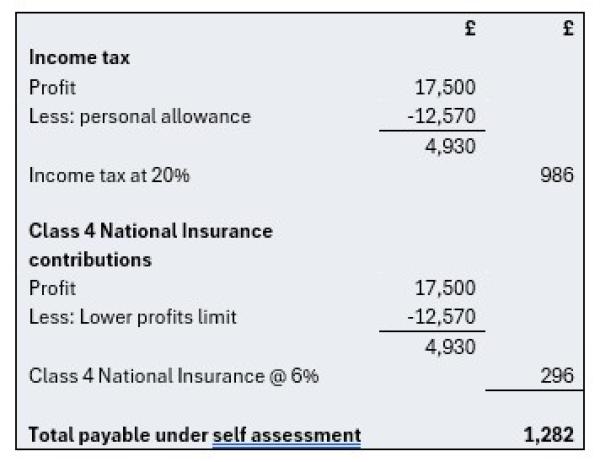
Example – payments on account with only self-employed income

Gaz is a self-employed window cleaner. In 2024/25, his trading profit was £17,500. He had no other income. Gaz’s self assessment tax calculation shows he has tax and class 4 National Insurance contributions to pay for the year of £1,282, as follows:

income tax and class 4 NIC calculation, which comes to £1,282
LITRG creation

As Gaz’s 2024/25 self assessment liability is more than £1,000, he will also need to make payments on account towards 2025/26, each being 50% of his 2024/25 tax bill.

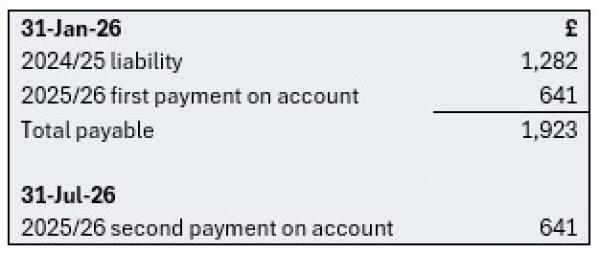
Let’s assume that this is the first year that Gaz’s self assessment liability has been more than £1,000, and so he has not made payments on account during the previous year. This will mean Gaz’s payment schedule for 2026 will look like this:

the total amount payable on 31 January 2026 is the total liability for 2024/25 plus the first payment on account for 2025/26. The second payment on account is due 31 July 2026
LITRG creation

As this is the first year that Gaz is required to make payments on account, he is facing a much larger tax bill on 31 January 2026 than he might have been expecting.

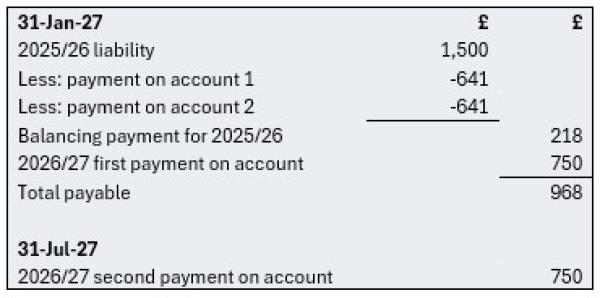
But, how do these payments on account affect Gaz’s position in the following year? Let’s assume that next year Gaz has a 2025/26 self assessment tax bill of £1,500. His payment schedule for 2027 would look like this:

the two payments on account are deducted from the tax payable on 31 January 2027. Further payments on account are also due for the 2026/27 tax year.
LITRG creation

As shown above, the payments on account reduce the final amount payable for the 2025/26 tax year. Gaz’s self assessment bill, before deducting the payments on account, is £1,500. As this is more than £1,000 Gaz has to make payments on account for the 2026/27 tax year. These are each 50% of his 2025/26 tax bill.

Example – payments on account when also employed

Genoveva is employed as a receptionist. In 2024/25, she also started to make and sell jewellery. Her taxable income in 2024/25 was £20,000 from employment (PAYE deducted £1,486) and she had profits of £6,000 from her jewellery business. Genoveva also sold some shares during the year and needs to pay capital gains tax of £300.

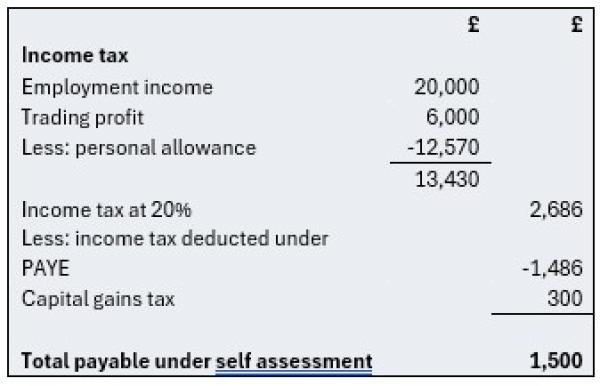
Genoveva’s 2024/25 self assessment calculation shows that she has total tax to pay of £1,500, as follows:

the image shows the calculation of Genoveva’s tax, which deducts the tax already paid at source under PAYE, and includes the capital gains tax. The total payable is £1,500
LITRG creation

Notes to the calculation:

  1. Genoveva does not pay class 4 National Insurance contributions, as her trading profit is under the lower profit limit.
  2. Even though Genoveva is paying capital gains tax under self assessment, this is not included for payment on account purposes.
  3. Genoveva’s total income tax for the year is £2,686.
  4. After taking off the tax deducted under PAYE, the balance of income tax payable under self assessment is £1,200 (£2,686 – £1,486).
  5. The tax deducted at source under PAYE is less than 80% of the total income tax for the year.

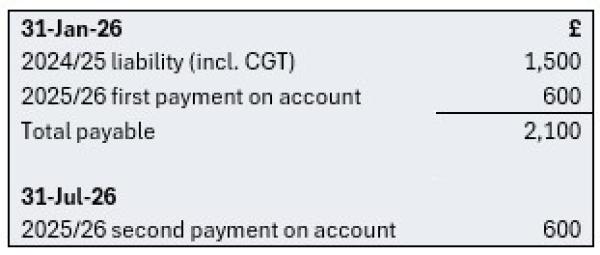
As a result, payments on account are due for 2025/26, each being 50% of the £1,200 income tax payable under self assessment. Genoveva’s payment schedule for 2026 will look as follows:

Image shows that the total amount payable on 31 January 2026 is the total liability for 2024/25, including capital gains tax, plus the first payment on account for 2025/26. The second payment on account is due 31 July 2026
LITRG creation

Again, like with the example of Gaz, Genoveva will be able to deduct the payments on account from next year’s self assessment liability.

Example – payments on account not due

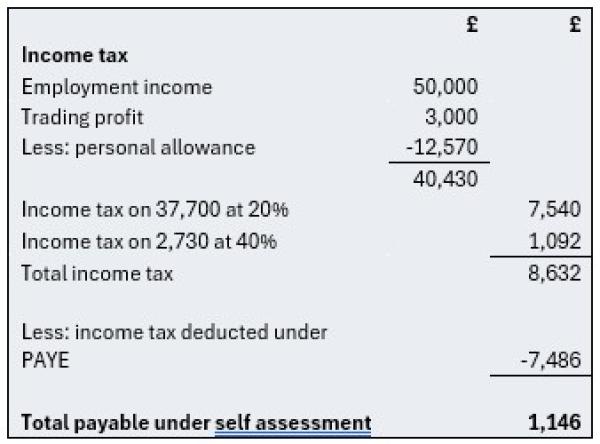
Morgan is employed as a project manager. He also does freelance event photography. His taxable income in 2024/25 was £50,000 from employment (PAYE deducted of £7,486) and he had profits of £3,000 from his photography business.

Morgan’s 2024/25 self assessment calculation shows that he has total tax of pay of £1,146, as follows:

image shows the calculation of Morgan’s tax, which deducts the tax already paid at source under PAYE. The total payable is £1,146.
LITRG creation

Notes to the calculation:

  1. Morgan does not pay class 4 National Insurance contributions, as his trading profit is under the lower profit limit.
  2. Morgan’s total income tax for the year is £8,632.
  3. After taking off the tax deducted under PAYE, the balance of income tax payable under self assessment is £1,146.
  4. In this case, the tax deducted at source under PAYE is more than 80% of the total income tax for the year (7,486 / 8,632 = 87%).

Even though Morgan’s self assessment liability is more than £1,000, he does not need to make payments on account, due to the proportion of tax deducted under PAYE. Morgan will only need to pay £1,146 by 31 January 2026.

Tax payment problems

As shown in the examples of Gaz and Genoveva above, if you have to make payments on account for 2025/26, then this can mean a larger tax payment on 31 January 2026 than you were expecting. There are some things you can do to help:

Reducing payments on account

If you expect your tax liability for 2025/26 to be lower than it was in 2024/25, then you can apply to reduce your payments on account. See our guidance for more information.

  If you reduce your payments on account too much – that is, you still have a balancing payment to make for the relevant year – then HMRC will charge interest on the excess reduction for each payment on account, back to when they were originally payable. In some cases, HMRC can also charge penalties if payments on account are reduced excessively and without a genuine reason.

Setting up a payment plan with HMRC

If you feel that you cannot afford to pay everything at once by 31 January 2026, you can consider arranging a payment plan with HMRC – known as a time to pay arrangement.

However, you will owe interest (at the time of writing, this is 7.75%) on late paid amounts, including those paid under a time to pay arrangement.

HMRC do not charge late payment penalties on late payments on account. However, if you cannot afford to pay by the relevant payment dates then it is usually a good idea to be proactive in arranging a payment plan with HMRC so that debt recovery action is avoided.

For more information, see our guidance at Tax payment problems and debt.

More information

We cover payments on account generally and in more detail in our guidance.

Payments on account are also discussed on GOV.UK.

We would love to hear what you think about this subject – you can share your comments below.

Please note all comments are moderated in line with our comment guidelines, so there might be a short delay before your comment is published if it meets the guidelines.

Heather Coley
Technical officer 

Comment guidelines

Comments

SallyAnn Simpson
It seems unreasonable to be charging interest on unpaid payments on account either if your income is pension only or your income fluctuates greatly. Where is the statutory underpinning for making it a compulsory part of self assessment, especially for pensioners and those with income below £20,000. I am expected to pay a paynent on account equivalent to all of one monthl's state pension amount in january and July each year. This is hardship.
LITRG
Thank you for your comment. The law related to self assessment payments on account is set out in section 59A of the Taxes Management Act 1970.

Add new comment

Back to top