Who does Making Tax Digital apply to?
Making Tax Digital for income tax affects individuals who have specific types of income above a certain threshold. This guidance covers who must use the new Making Tax Digital reporting system.

Content on this page:
Who needs to use Making Tax Digital?
Making Tax Digital for income tax will eventually affect self-employed individuals and individuals receiving property income with annual gross income of more than £20,000 from their self-employment and/or property letting. It is being introduced over three tax years from April 2026 (the 2026/27 tax year).
Those with annual gross income (known as qualifying income) of more than £50,000 must follow the new Making Tax Digital rules from April 2026 unless they are exempt (see below).
What is the Making Tax Digital threshold?
The Making Tax Digital threshold is an amount of annual gross income, which, if exceeded, means you are legally required to use Making Tax Digital, unless you are exempt.
From April 2026, the threshold is £50,000, but over the next few tax years the annual gross income (known as qualifying income) threshold gradually reduces as follows:
- gross income above £50,000 on 2024/25 tax return - you must use Making Tax Digital from April 2026 unless exempt
- gross income above £30,000 on 2025/26 tax return - you must use Making Tax Digital from April 2027 unless exempt
- gross income above £20,000 on 2026/27 tax return - you must use Making Tax Digital from April 2028 unless exempt.
Those with annual gross income of £20,000 or less from these sources are not in scope of Making Tax Digital under current rules. You can choose to follow the Making Tax Digital rules voluntarily if you want to, even if you are not legally required to do so.
What is qualifying income?
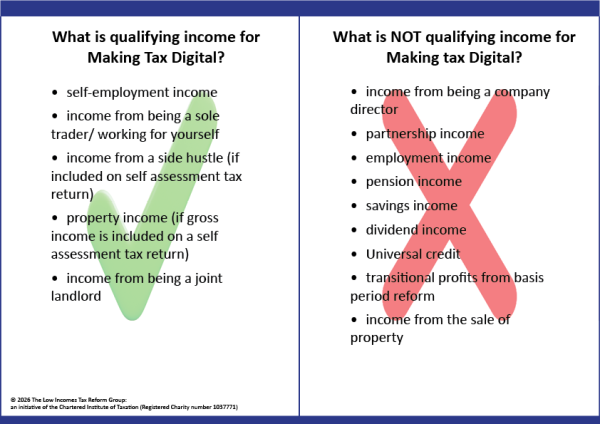
Reporting under Making Tax Digital only applies if you have annual gross income (also called qualifying income) above a certain amount from self-employment and/or property.
So, when looking at the Making Tax Digital thresholds above you must only look at your gross income from:
- Self-employment; and
- Property income
Therefore, you do not include other sources of income such as those from:
- Partnerships
- Being a company director
- Employment income (PAYE income)
- Pension income
- Savings income
If you only have income from one or more of the sources listed directly above and you do not have any self-employment or property income, then you will not be in Making Tax Digital under current rules.
The government has confirmed that Making Tax Digital for income tax will become mandatory for partnerships in due course, but it is not yet known when this will be. But individual partners with other qualifying income are in scope of Making Tax Digital. For example, a partner in a trading partnership with personal gross rental income of more than £50,000 would still have to follow the new Making Tax Digital rules from April 2026, unless they were exempt.
How does Making Tax Digital work in practice?
The examples below show how to work out what your qualifying income is in different circumstances.
What to do next
Check your sources of taxable income to identify if you have the types of income that count as qualifying income under the new Making Tax Digital system – income from self-employment and property income.
If you have these types of income, you should work out the amount of gross income; there is more information on this in our Making Tax Digital guidance for the self-employed and for landlords. You should check when you must start using Making Tax Digital.
You may want to check whether you are or could be exempt from the Making Tax Digital requirements.
Remember if you do not need to report your income through Making Tax Digital then you should continue to report your taxable income through the self assessment tax system.