Making Tax Digital Exemptions
Not everyone is required to follow the new Making Tax Digital for income tax rules, even if their gross income exceeds one of the Making Tax Digital thresholds. There are various exemptions and deferrals that apply, and we explain these below.
Content on this page:
Types of exemptions from Making Tax Digital
There are different types of exemptions under Making Tax Digital. Exemptions can either be permanent or temporary. Some exemptions apply automatically, whereas others must be applied for. More information can be found below on the different types of exemptions.
Automatic exemptions from Making Tax Digital
There are a small number of individuals who are automatically exempt from Making Tax Digital. These exemptions apply either for an unlimited period, for one tax year only, or for as long as the individual’s circumstances stay the same.
If you fall within any of these categories, you will not need to follow the new rules, unless your circumstances change – see the heading ‘If your circumstances change’ below.
Permanent exemptions
The following categories of exemptions are permanent:
- If you are a foster carer or shared lives carer and qualifying care receipts are your only income.
- If you are a trustee submitting a tax return on behalf of a trust.
- Visiting performers (non-resident entertainers and sportspeople).
Tax-year specific exemptions
The following categories of exemptions are tax year specific. These exemptions will depend on an individual’s circumstances in a specific tax year. For these types of exemptions, individuals must look at their Making Tax Digital start date and check whether their circumstances in the relevant tax year exempt them. For example, for those with a start date of 1 or 6 April 2026, it would be the 2024/25 tax year that is relevant in determining whether one of these exemptions apply.
The tax-year specific exemptions are as follows:
- If you do not have a UK National Insurance number on 5 April prior to the start of the tax year, you will be automatically exempt for that tax year (but see below).
- Individuals whose tax return for the relevant tax year shows they are subject to a power of attorney (or deputyship as appointed by the court of protection) and are not capable of providing financial information to HMRC.
- If you are a personal representative (executor) dealing with the tax affairs of a person’s estate or their tax affairs up to the date they died.
- If you are a Lloyd’s underwriter who has completed the supplementary SA103L pages of the tax return for the relevant tax year.
- Individuals who claim the blind person's allowance.
- Individuals who claim the married couple's allowance. (Note that this is different to the transferable marriage allowance.)
- Ministers of religion.
Automatic exemptions that last until April 2027
There are groups of individuals who are exempt from using Making Tax Digital for 2026/27 only, so these are essentially deferrals for one year. It is expected that the categories of individuals below will be required to follow the rules of Making Tax Digital from April 2027, assuming they meet the relevant income conditions. These are:
- those who have received income from trusts or estates and completed the SA107 supplementary (Trusts) pages as part of their 2024/25 tax return.
- foster carers/shared lives carers who have qualifying care receipts and also other types of qualifying income.
- Those who made averaging claims on their 2024/25 tax return using the SA103 supplementary page as an individual (for example, farmers or creative artists.)
- Individuals who completed the SA109 supplementary pages as part of their 2024/25 tax return.
Note that the relevant legislation for Making Tax Digital for Income Tax only exempts individuals who have had to complete the SA109 pages of the tax return for a number of specific reasons (such as those who have been non-UK resident). However, HMRC’s guidance specifies that all individuals who completed the SA109 pages as part of their 2024/25 tax return are exempt until April 2027 at the earliest.
There is information about all the exempt groups on GOV.UK
Do I need to apply for an exemption?
You may need to apply for an exemption, depending on your circumstances.
If HMRC know that your personal circumstances mean you are in one of the groups that are automatically exempt (for example, if you have claimed blind person’s allowance on your 2024/25 self assessment tax return) then you should not need to apply for the exemption. However, if there has been a change in your circumstances that means you now come within one of the exempt groups for the first time and you reasonably expect your 2025/26 or 2026/27 tax return to reflect this in due course, you will need to tell HMRC.
In other words, the general rule is that if the reason for your exemption was shown on your 2024/25 tax return, exemption should be automatic. If the reason was not on your 2024/25 tax return, so HMRC don’t know about it, you need to apply.
HMRC’s have confirmed that you must apply for an exemption if you are a partner in a partnership and have used the SA104 supplementary page to claim averaging relief on your 2024/2025 tax return and expect to claim this relief again in 2025/26 or 2026/27.
Digital exclusion exemption from Making Tax Digital
It is possible to apply for exemption from Making Tax Digital for Income Tax if you are digitally excluded – for example, if disability prevents you from using computers or if you live in a remote location with poor broadband access.
The law states that a person is digitally excluded if for any reason (including age, disability, or location) it is not reasonably practicable for them to use electronic communications or to keep electronic records.
You can also apply for exemption if you are a practising member of a religious society (or order) whose beliefs are incompatible with using electronic communications or keeping electronic records.
How to apply for an exemption from Making Tax Digital
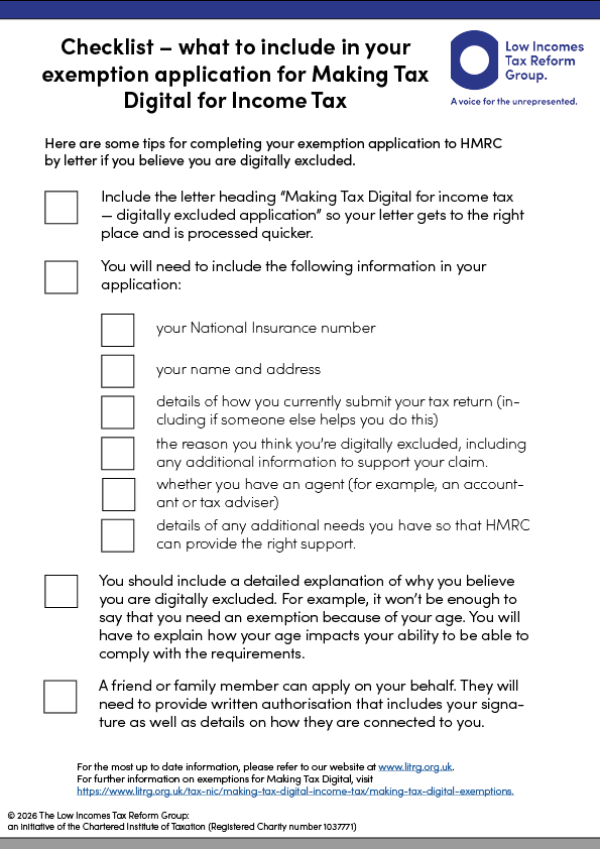
To claim an exemption, you need to contact HMRC by either phone or letter. HMRC’s guidance sets out what they need to know when you contact them. A friend or family member can help you with this. HMRC will aim to process your application within 28 days and will respond via letter, which should explain whether you have been granted an exemption and if so, how long this exemption will last for.
HMRC have advised that each taxpayer’s exemption application will be considered on a case-by-case basis and that you should continue to prepare for Making Tax Digital whilst you are waiting for a response. This may include researching potential software options, for example. See our checklist below for some useful tips on making an exemption application.
Making Tax Digital for VAT exemptions
There is a slightly different exemption process if you are VAT registered and have already been granted an exemption from Making Tax Digital for VAT. In this case, you should contact HMRC by telephone or in writing to confirm that your circumstances have not changed and you want the exemption to apply for Making Tax Digital for Income Tax.
You will need to tell HMRC your National Insurance number, VAT registration number, and the reason you are digitally excluded from Making Tax Digital for VAT, as well as details of any changes in circumstances or confirmation that your circumstances have not changed.
If your circumstances change
If your exemption application is accepted, you must make HMRC aware if your circumstances change in future if this means you are no longer digitally excluded. For example, if your application was accepted on the basis of living in a remote location with no reliable broadband, but you then move house. This must be done within 3 months of the change of circumstances.
The detailed guidance on applying for exemption is available on GOV.UK.
What to do next
If you have applied for an exemption and this is accepted, you will still have to maintain records and submit annual self assessment tax returns as normal.
If your exemption application is not accepted, you should prepare to comply with the requirements of Making Tax Digital. If you disagree with HMRC’s decision to not grant an exemption, you can appeal within 30 days of the date on the decision letter. Information on how to appeal is included on GOV.UK.
Checklist – what to include in your exemption application for Making Tax Digital for Income Tax
Making Tax Digital exemption application check list by LITRG