Capital gains tax
Capital gains tax is a complicated subject, so we provide an introduction only. We do cover the main issues, though, and signpost you to where you may find extra help.
Content on this page:
Overview
Capital gains tax (also known as CGT) is a tax charged if you sell, give away, exchange or otherwise dispose of an asset and make a profit or 'gain'.
It is not the amount of money you receive for the asset but the gain you make that is taxed.
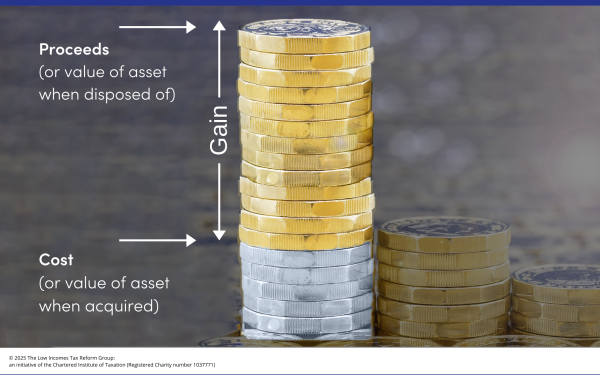
Broadly, to calculate the gain, you compare the sale proceeds (or value of the asset at the time it was disposed of) with the original cost of the asset (or value when it was acquired). This is illustrated below:
You can find a basic guide to capital gains tax on GOV.UK.
When capital gains tax applies
As noted above, CGT applies when you sell, give away, exchange or otherwise dispose of a capital asset. A capital asset is something that you own such as a house, shares in companies or other possessions.
Some assets are specifically exempt from capital gains tax. We discuss exempt assets below.
If you are a UK resident, you are usually liable to capital gains tax on disposals of assets located anywhere in the world, not just your UK-located assets. There are some exceptions to this. The rules vary depending on whether the asset was sold before or after 6 April 2025. You can read more about these rules:
- For disposals up to 5 April 2025 see our page Remittance basis of taxation.
- For disposals from 6 April 2025 see our page Foreign income and gains from 6 April 2025.
Non-UK resident disposals
Non-UK resident individuals are not usually liable to UK capital gains tax on the sale of UK assets, but this is subject to some exceptions. See our page Non-residents and capital gains tax.
Gifts and other disposals
You may have to pay capital gains tax when you give an asset as a gift to someone.
The rules are different depending on who you give the gift to and there are special reliefs for gifts of business assets. We do not cover the relief for gifts of business assets here, but you can find information on GOV.UK.
Capital gains tax can also apply if you transfer assets on separation, divorce or dissolution of a civil partnership.
In some cases, you are treated as if you have disposed of an asset. This might happen, for example, if a personal possession, such as an antique, has been destroyed and you have received a capital sum, such as an insurance pay-out, by way of compensation.
Inherited assets
You may have to pay capital gains tax if you sell, give away or exchange an asset you inherited from a deceased estate. Where an asset has been inherited, the ‘cost’ for the purposes of calculating the gain will usually be the market value of the asset at the date of death.
Exempt assets
As already mentioned, some assets are specifically exempt from capital gains tax. Some of the most common examples are:
- private motor cars, including vintage cars
- gifts to UK registered charities
- some government securities
- prizes and betting winnings
- cash
- stocks and shares held in an ISA
- foreign currency held for your own use
- sales that are otherwise taxed as trading or miscellaneous income
The disposal of your main home is often free of capital gains tax, but this is not always the case. The capital gains tax relief that can be applied on disposal of your main home does not apply to second homes or properties which are rented out, though part of those gains might qualify for relief if the property has previously been your only or main residence. You can read more about the relief on our page Selling your home.
If you sell or give away personal belongings (‘chattels’) then there will be no capital gains tax if your share of the proceeds or value when given away is less than £6,000. See our separate guidance for more information.
Calculating gains
You normally work out your gain by taking the proceeds (or in some cases, the market value on the date of disposal) and then deducting all of the following:
- original cost (or in some cases, market value when acquired)
- incidental costs of purchase
- costs incurred in improving the asset
- incidental costs of sale
This then gives you the chargeable gain.
Proceeds
Your proceeds will usually be the amount you received for the asset on sale. However, if you give away an asset, or sell an asset for less than what it is worth, HMRC will usually treat you as having sold it for what it is worth (that is, the market value). You can read more about this on our page Capital gains tax on gifts.
Original cost
In terms of costs, if you bought the asset, you would normally use the actual amount paid for the asset as your ‘original cost’. However, there are some exceptions.
- If you are selling an asset you owned at 31 March 1982, you use the market value as it was on 31 March 1982 – the amount you could have sold it for on the open market at that date – instead of your original cost.
- The ‘cost’ for capital gains tax purposes might also be different if the asset was received as a gift. See our page Capital gains tax on gifts for more information.
- The cost for capital gains tax purposes may be different if it is a non-UK asset and you claimed the remittance basis prior to 5 April 2025. See our page on the Remittance basis of taxation for more information.
Improvement costs
When you improve or add to your asset, you can deduct this cost in the calculation (this will reduce the gain). You can only include improvements, for example, an extension to a house, and not repairs.
Costs of purchase and sale
Similarly, you can deduct the incidental costs of buying and selling in the calculation. Typical costs include legal expenses and estate agents' fees for property, and broker's commission on the purchase and sale of shares.
We discuss these elements further under Capital gains tax reporting and Capital gains tax record-keeping.
Part disposals
Where you dispose of only part of an asset (other than shares – see our separate guidance), you work out your cost by taking your sale proceeds and dividing them by the total of sale proceeds and the market value of the unsold part. This is then multiplied by your overall cost like this:
Cost of the part disposed of = A x B/C, where
A = overall cost
B = sale proceeds
C = sale proceeds added to the market value of the unsold part.
Small part disposals of land
If you sell part of a holding of land for £20,000 or less and the proceeds are not more than 20% (1/5th) of the value of the whole piece of land, you can elect not to have made a disposal; but the amount of proceeds you receive is taken off your cost which is used to calculate any future disposal.
You cannot make the election if you have other disposals of land in the same year and the total of proceeds for all disposals is more than £20,000.
See HMRC’s capital gains manual CG71870 on GOV.UK for more information.
The annual exempt amount
Each tax year, most individuals who are resident in the UK are allowed to make a certain amount of capital gains before they have to pay capital gains tax. This is because they are entitled to an annual tax-free allowance, called the annual exempt amount (also known as AEA). It is also sometimes referred to as the annual exemption.
The Annual exempt amount has reduced in recent years:
| Tax year | Annual exempt amount |
| From 2024/25 onwards | £3,000 |
| 2023/24 | £6,000 |
| 2022/23 | £12,300 |
Any unused annual exempt amount cannot be carried forward or back. Each spouse or civil partner gets their own annual exempt amount.
If you have gains from more than one disposal in a tax year and the gains are charged to capital gains tax at different rates, you can choose which gain to set the annual exempt amount against to minimise your capital gains tax liability. This can be done by deducting the annual exempt amount from the gain(s) that are charged at the highest rate of capital gains tax.
Note: If you have capital losses, either from disposals made in the same year or losses brought forward from an earlier tax year, you can also set them against your capital gains in the most beneficial way to minimise your capital gains tax liability. You can read more about this in our guidance on capital losses.
Up until the 2024/25 tax year, individuals who were resident in the UK, but not domiciled here, and who used the remittance basis of taxation (other than in the case where the remittance basis applied automatically because unremitted foreign income and gains were less than £2,000) were not entitled to an annual exempt amount.
Individuals who are non-resident who may be liable to capital gains tax on the disposal of UK land and property are entitled to an annual exempt amount.
Rates of capital gains tax
For disposals in 2025/26 and 2026/27 the main rate of capital gains tax is 18% for basic rate taxpayers. For higher or additional rate taxpayers, the rate is 24%. If you are normally a basic-rate taxpayer but when you add the gain to your taxable income you are pushed into the higher-rate band, then you will pay some capital gains tax at both rates.
Note that there are some exceptions to the rates quoted above, such as where the gain relates to carried interest or where the disposal qualifies for business asset disposal relief, but we do not cover these here. You can read more on GOV.UK.
Welsh and Scottish taxpayers
If you live in Scotland and are a Scottish taxpayer, or in Wales and are a Welsh taxpayer, the same rules as explained above apply to you. You must consider your total income and gains in relation to the UK rates and bands to work out your capital gains tax, even if you pay income tax at the Scottish or Welsh rates and bands on your salary, self-employed profits, rental income or pension.
2024/25 capital gains tax rates
Capital gains tax rates usually apply consistently for a whole tax year. However, in the 2024/25 tax year there was a change in capital gains tax rates for certain assets part way through the tax year. We have information about the special rules that applied for disposals in the 2024/25 year in our separate guidance.
Jointly owned assets
Each of you is usually liable to tax on your half of any gain arising, assuming the asset is owned equally. If it is not, you are each assessed to tax based on your share of the asset. You can read more about jointly owned property generally on our page Joint income from property.
Date of disposal
The date of disposal for capital gains tax is usually the date that you enter into an unconditional contract.
This means that for property, this is the date that contracts are exchanged and not the date of completion when possession of the property is actually taken.
However, note that there is a 60-day window for reporting any capital gains tax due on disposals of UK residential property (or, if you are non-resident, for reporting all disposals of UK land or property). This begins from the date of completion.
For shares, it is the date the bargain actually took place and not the date of the contract note or the date of settlement.
If, instead, you enter a conditional contract, the relevant date is the date when the conditions are satisfied. Let’s say, for example, someone agreed to buy a house that you own on the condition that the broken-down central heating boiler is replaced. The terms of that work might be set out in an agreed contract. The disposal date for the house for capital gains tax purposes would be when the work was agreed to have been completed to the terms of the contract, not the date the contract was agreed.
Delayed or deferred sale proceeds
When you sell an asset, sometimes you receive only part of the money at the date of sale. You may receive further amounts later and some may be dependent on future events. This is called deferred consideration.
Depending on the type of deferred consideration involved, you may need to take it into account immediately when working out your gain or loss for the disposal even though you do not receive it until sometime later.
Generally, if you know the amount of money that you will be receiving, even if it is not payable until a later time, then you include it when calculating the gain or loss.
For example, if the deferred amount consists of an immediate payment followed by a number of instalments, the figure of total proceeds is known in the year of disposal and should be included in your capital gains tax computation even though the actual money will not be received until later.
We are not going to look here at the situation where the amount of the deferred payment is not known as this is more complicated and may require a valuation of the deferred amounts.
Where the disposal proceeds for an asset are payable to you by instalments, you may, in certain circumstances, ask HMRC if you can pay any capital gains tax due by instalments (in recognition that you may not have the money to pay the capital gains tax otherwise).
This relief is available where the instalments, as set out in the contract for sale of the asset:
- begin no earlier than the date of disposal of the asset,
- extend over a period exceeding 18 months, and
- continue beyond the date on which the tax would otherwise be due and payable.
HMRC guidance states that such an application must be made in writing to them. See their capital gains manual CG14910 and self assessment manual SAM80072 on GOV.UK.
Further information
You can find a collection of information on capital gains tax on GOV.UK.
For HMRC’s detailed and technical capital gains tax information see the capital gains tax manual on GOV.UK.
You may need professional advice when disposing of assets, as capital gains tax can be complicated. Other taxes, such as stamp duty, stamp duty land tax (and similar taxes in the devolved parts of the UK) might also apply on the transfer of property. Giving assets away can also haveinheritance tax consequences. Our Getting help pages give guidance on finding a tax adviser.