Self assessment tax payments
Self Assessment payments usually become due on 31 January each year. Sometimes payments are also due on 31 July too. Here we explain which Self Assessment tax payments are due on each of these days.
Content on this page:
Normal due date
Usually, Self Assessment payments (which can be made up of income tax, class 2 and 4 National Insurance contributions (also known as NIC) and student loan repayments) are due by 31 January following the end of the tax year to which they relate. So, payments for the 2025/26 tax year are due by 31 January 2027.
These payments are sometimes referred to as the ‘balancing payment’.
There is an exception where:
- you registered for Self Assessment on time (or otherwise notified HMRC on time that you owed tax for the year) – see Registering for Self Assessment, but
- HMRC did not give you a notice to file a tax return until after 31 October following the end of the tax year.
In this case, your Self Assessment balancing payment for the year is instead due three months after the date of the notice to file.
Payments on account
Some taxpayers need to make instalment payments towards their annual Self Assessment bill. These are called payments on account.
Generally speaking, if you need to make payments on account, you will need to make payments on 31 July in each tax year as well as on 31 January. These are in addition to any balancing payments that may also be due on 31 January. For more on this see the How much to pay section below.
You normally have to make a payment on account if your income tax payment (together with any class 4 National Insurance contributions if self-employed) for the previous year was over £1,000, unless more than 80% of your previous year’s income tax was taken off at source.
Income tax will be taken at source if, for example:
- you are employed, in which case tax will probably be deducted through pay as you earn (also known as PAYE) from your employment income, or
- if you are a self-employed subcontractor and come within the construction industry scheme (also known as CIS), in which case you will probably have deductions of tax made by contractors from your invoices.
You may need to make payments on account for the first time if your tax bill is higher than it was previously.
It can be quite a shock to your cash flow when you first move to payments on account. This is because the first payment on account for the current tax year will be due at the same time as the full payment for the previous tax year, as we describe below in the section How much to pay. It may help you to put aside a certain amount each time you get paid into a different bank account (see below under the heading Preparing for your tax bill).
If you prepare your tax return as soon as possible, it will give you more time to save up for both the tax which is due for that year and your payments on account for the following tax year.
How much to pay
Payments on account are based on your total income tax (and class 4 National Insurance contributions if you are self employed) for the previous year, as explained in our Payments on account section above. Each payment on account is 50% of that previous year’s liability.
If you need to make payments on account, they are due on:
- 31 January during the tax year, and
- 31 July following the end of the tax year.
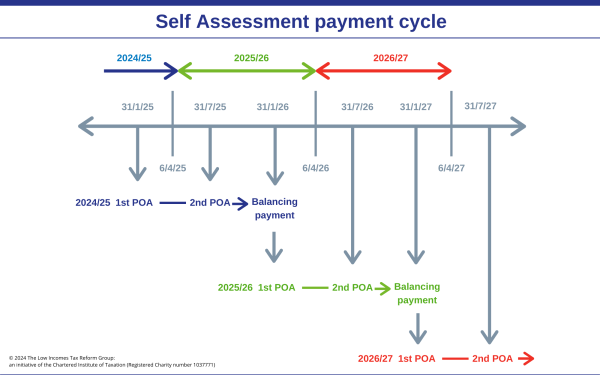
On 31 January, you also pay any balance of income tax (and class 4 National Insurance contributions if applicable) due for the previous tax year (together with any voluntary class 2 National Insurance contributions due for that year if you are self-employed). So, you may have two amounts to pay, being:
- the balancing payment for the previous year, and
- the first payment on account for the current tax year.
However, you pay both together as a single total.
Therefore, if you are liable to payments on account, the typical payment cycle looks like this:
For a further example of how payments on account work and guidance on how to budget for your tax bill, see Paying tax on self-employed profits and making payments on account.
Extra tax due following a tax return amendment
If HMRC make an amendment to your tax return, or you notify them of an amendment that will increase the tax due, any extra tax will be payable 30 days from the date of the amendment (although interest will run from the date that the tax should have been paid).
If the amendment increases your income tax due and you are also required to make payments on account for the following tax year, you will find that these will also increase. The additional payment on account amounts will need to be paid, and interest will run from the dates that the payments on account should have been made also.
Reducing your payments on account
You can apply to reduce your payments on account if you think you are going to be paying more than you need to (that is, you think the next tax year’s income tax (and class 4 National Insurance contributions, if applicable) bill will be lower than the one on which the payments on account are based). For example, this might be the case if you have a self-employment business and know that your taxable profit will be lower this year due to a large expense you had to pay, but your income from other sources continues at the same level as the previous year.
You can reduce your payments on account at any time using form SA303 either online or in paper form up to when the balancing payment is due. You will need to calculate the reduced payment on account amount – HMRC will not calculate this for you. You will also need to tell HMRC the reason for your claim.
If you know you will need to reduce your payments on account for the next tax year when you are completing your tax return, you can also make the claim in the tax return form itself, giving details of the circumstances in the additional information pages of the return.
If you reduce your payments on account below what they should in fact have been (once the final liability is known), you will have to pay interest on the shortfall from the date each payment on account was due. In some cases, HMRC may charge a penalty if the reduction is excessive.
For an example of reducing payments on account, see our page Paying tax on self-employed profits and making payments on account.
Reducing your payments on account after paying them
If you have already paid payments on account, you can still reduce them by completing form SA303.
Any excess that you have paid can be refunded to you as long as it is at least 30 days until your next payment is due, or it can be held by HMRC and set against the next payment when it becomes due. If your next payment is due within 30 days, the refund will automatically be held and will be set against the next payment due. HMRC will pay interest on any excess you have paid. The current interest rate can be found on GOV.UK.
Preparing for your tax bill
If you pay tax under Self Assessment, it can sometimes be difficult to ensure you have enough money to pay HMRC when the payment deadline arrives. It is often a good idea to put money aside regularly to pay your tax.
Budget payment plans (or ‘pay weekly or monthly’)
It is possible to pay your tax weekly or monthly in advance by direct debit, by setting up a budget payment plan with HMRC.
A budget payment plan is a regular payment arrangement with HMRC towards your future tax bill. With a HMRC budget payment plan, you get to choose how much you pay and how often. If the amount paid under the budget payment plan is less than your actual tax liability, then you will have to pay the remaining balance of any tax by the normal deadline.
- How budget payment plans work
-
Budget payment plans are optional and they are different to making payments on account. The idea behind a budget payment plan is that you pay a regular amount to HMRC for a period of time before the payment deadline. You can pause the payments for up to 6 months if you need to.
You can decide how much you pay under the plan – the idea is that you are putting aside a regular amount towards your tax bill. The payments made under the budget payment plan are then deducted from your final tax bill for the year.
If your tax bill is less that the total regular payments made under your budget payment plan, then you will need to pay the remaining balance by the normal payment deadline. If your final tax bill is less than the total tax paid under a budget payment plan, you will be entitled to a tax refund.
Example - Marianne
Marianne only has income from her state pension and a small rental property. She usually has an income tax liability each year of around £800 under Self Assessment. She hasn’t yet prepared her tax return for 2025/26, but on 1 October 2026 she sets up a budget payment plan with HMRC. Marianne decides to pay £200 under the plan each month and hopes that this will cover her tax liability becoming due on 31 January 2027.
On 15 January 2027, Marianne completes and submits her tax return. Her tax liability is £950, which is higher than she expected. Her tax payment position on 31 January 2027 is as follows:
£
2025/26 tax liability due 31 January 2027 960
Deduct: amount paid under the budget payment plan -800
Balance due by 31 January 2027 160
From 1 February, Marianne will need to look again at her budget payment plan. It is unlikely that she will want to continue paying £200 per month as this will most likely far exceed her future tax liability. If she expects her 2027/28 tax liability to be the same as the 2026/27 amount, she may decide to make monthly payments of £80 from 1 February 2027 to 31 January 2028 (that is, 12 payments of £80 = £960).
If Marianne was required to make payments on account towards her 2026/27 liability she would need to reconsider her budget payment plan. She will need to make sure that the payments on account are paid by the due dates of 31 January 2027 and 31 July 2027.
- Who can set up a payment plan
-
Using a budget payment plan is completely optional.
HMRC say that that you need to meet the following criteria to be able to set up a budget payment plan:
- You must be up to date with all Self Assessment payments; and
- You must not be under an existing time to pay arrangement.
HMRC have a tool that you can use to check if you are eligible to set up a budget payment plan.
If you are repaying a student loan, you may wish to read our guidance about how a budget payment plan works with your repayments. We have separate guidance for Plan 1 and Plan 2 student loans.
If you decide you do wish to enter a budget payment plan, we have some useful information about identifying your taxable income and how tax is calculated here.
By putting money aside using a budget payment plan, you no longer have immediate access to the money. However, ahead of the tax payment deadline you can request a repayment of any amounts paid under a budget payment plan if an unexpected need for the money arises. If the total you pay to HMRC under a budget payment plan turns out to be more than your actual tax liability you will get a refund of excess amount paid.
Example - Jesse
Jesse started trading as a self-employed electrician in May 2024. In the 2024/25 tax year his tax liability was £800, which he paid by the payment deadline of 31 January 2026. Since his tax liability was less than £1,000, he was not required to make payments on account towards 2022/23.
Jesse wanted to avoid having to find such a large amount of money for his tax payment for the following year and decided he would rather put aside a regular amount of money towards this liability. On 1 March 2026, he set up a budget payment plan with HMRC, choosing to pay a weekly amount of £25 by direct debit.
Jesse completes and submits his 2025/26 tax return on 15 December 2026. His tax liability for 2025/26 is £950. Since 1 March 2026, Jesse has paid 41 weeks’ worth of £25 under his budget payment plan – so he has already paid £1,025 to HMRC. Jesse is therefore able to claim a refund of £75 from HMRC. Alternatively, Jesse could leave the credit on his account to be set against any future tax liability.
- If you can no longer afford your payments
-
HMRC say that you can pause payments under your budget payment plan for up to six months if you need to. You can also simply cancel the arrangement at any time if it is no longer affordable, but it is important to remember that the tax liability will still be due by the normal payment date.
If you decide to cancel or pause any payments under a budget payment plan that you have previously set up, you will be faced with a larger tax payment when it comes to settling your tax liability at the deadline date.
- If you have missed the tax payment deadline
-
Budget payment plans are only used to pay future tax liabilities. If you have fallen behind with your tax payments, then you will need to bring these up to date before entering into a budget payment plan. This includes being in a ‘time to pay’ arrangement – any time to pay arrangement must have come to an end before you are able to start a budget payment plan.
You may, however, instead be able to agree a time to pay arrangement with HMRC to help you catch up and then look at a budget payment plan in future. We set out more information about late payment of tax and time to pay arrangements here.
- How to set up a budget payment plan
-
You can use your online HMRC personal tax account to set up a budget payment plan. You can read more about personal tax accounts and how to set one up on our page Online tax accounts.
When you access your personal tax account, click the ‘Direct Debit payments’ link and follow the instructions for setting up the direct debit. Towards the end of the process you can confirm if you wish to make a single payment or a budget payment plan. You can then go on to confirm how much you want to pay and how regularly, and can also provide a start and end date for payments.
If you do not have access to your personal tax account, you can set up a budget payment plan over the telephone by calling HMRC’s Self Assessment payment helpline. You can find the contact number on GOV.UK.
Setting the money aside in the bank
You might prefer to set cash aside but keep the money aside in your own account to save towards a future tax liability – for example, by making a weekly or monthly transfer to a separate bank account. This will mean that the money could be available immediately if an unexpected financial need arises. You might also be able to earn some interest on the money. You will need to make sure that you are able to access the money so that you can pay your tax liability by the deadline.
How to pay your tax bill
There are various ways to settle any payments due and these include cheque, bank transfer, debit card, but not personal credit card. See GOV.UK.
Make sure you have the correct reference number when you make any payment, so that HMRC correctly allocate it to your account. This will be your 10-digit unique taxpayer reference (UTR), usually followed by the letter K.
You will not automatically be issued with a payslip by HMRC in advance of the payment dates on 31 January and 31 July. If you do not receive a payslip, you should organise payment anyway otherwise interest charges will apply and you might incur a fine for late payment and not receiving a payslip from HMRC will not be accepted as a reasonable excuse for late payment.
If you are having difficulty meeting a tax bill or know that you will have difficulty paying a bill that becomes due in the near future, see Tax payment problems and debt.
Paying your Self Assessment bill via PAYE
If the amount you owe to HMRC by 31 January following the end of the tax year is less than £3,000 and you have income that is taxed under Pay As You Earn such as from an employment or personal pension, it may be collected via your tax code in the following tax year. This is known as ‘coding out’.
If you want to take this option, you will need to send in your tax return by 31 October on paper, or by 30 December if you are filing online. If you have filed within these time limits and the tax does not appear to be collected this way, you should contact HMRC to query this.
Class 2 National Insurance contributions cannot be coded out in this way and must be paid by 31 January following the end of the year. Note that from April 2024 Class 2 National Insurance contributions are now voluntary.
In addition, amounts cannot be coded out where it would lead to more than 50% of your employment or pension income being deducted under Pay As You Earn.