Value-added tax (VAT)
Value added tax (VAT) is a sales tax charged by VAT registered traders on the value of goods and services supplied to their customers in the UK. VAT is a complex tax and this section gives a basic overview only. The concept of a supply of goods and services is specific to VAT law. The most common ‘supply’ of goods and services by a VAT registered business is a sale.
Content on this page:
The basics
In a supply chain, each person, from the first supplier to the final consumer, is charged VAT on taxable supplies to them if they are received from a VAT registered supplier.
To see how VAT works in practice, it is best to look at an example:
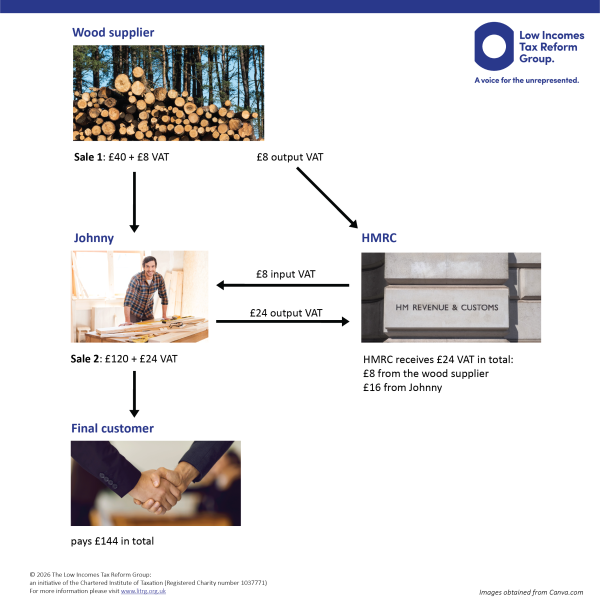
In general, VAT-registered businesses do not suffer the burden of VAT, apart from having to administer it. The VAT cost effectively falls on the final consumer.
However, businesses that cannot offset or recover all the VAT that they pay on their purchases do suffer a cost from VAT.
VAT threshold
The law requires UK traders with sales (turnover) above the VAT threshold to register for VAT and charge it on supplies of goods or services. The trader charges the VAT and then pays it over to HM Revenue & Customs (HMRC), the government’s tax-collecting authority.
Traders whose sales are below the VAT threshold do not need to register for VAT (but can do so voluntarily) so not all traders are required to be VAT-registered.
We explain about compulsory and voluntary VAT registration on our page VAT when running a business.
VAT rates
There are three rates of VAT.
The standard rate of VAT is 20%. Certain items are charged at lower rates. For example, children’s clothing is charged at the rate of 0% whereas household fuel such as gas and electricity is charged at the reduced rate of 5%.
The rate of VAT was reduced temporarily for some businesses such as hospitality and tourism which were severely hit by the coronavirus pandemic. The temporary reduction ceased on 31 March 2022. For more information on this see GOV.UK.
Some specific supplies are exempt from VAT – these are listed in VAT law and include things such as supplies of insurance and of postal services.
If a business just makes exempt supplies and does not make any taxable supplies then it cannot register for VAT and so cannot reclaim VAT paid on its purchases.
Businesses that make taxable supplies (charged at 20%, 5% or 0%) can reclaim VAT that they have paid on their purchases.
If a business makes a mix of taxable and exempt supplies, then it is known as a ‘partially exempt’ business and it is likely it will be able to reclaim a proportion of the VAT paid on its purchases.
More information
There is more information about registering for VAT and VAT for businesses on our page VAT when running a business.
There is more information about the processes involved in dealing with VAT on our page Reporting and paying VAT.