Help with employment status
HMRC can help you determine whether you are employed or self-employed for tax purposes.

Content on this page:
HMRC publications
There is basic guidance on employment status on GOV.UK.
HMRC also have a factsheet (ES/FS1) on GOV.UK that will help you check your employment status.
HMRC have more detailed and extensive material about employment status in their employment status manual.
This includes sector specific hints and tips – for example, for care workers.
It also contains detailed guidance on all the different status factors and concepts. For example, we know substitution and control seem to be difficult to understand – HMRC have specific guidance on the following pages:
- Right to substitution (ESM0530 – ESM0538)
- Control (ESM0516 – ESM0529)
CEST tool
HMRC also offer an online tool on GOV.UK called check employment status for tax (CEST). It will ask you a set of questions about your situation and at the end it will give you an indication of your employment status for tax.
The tool helps you determine status in the context of IR35/off payroll if you are a limited company, but also whether direct engagements are classed as employment or self-employment for tax purposes.
You can print or save the CEST tool determination as a PDF for your records, which may help if HMRC later query your tax status or you need to show your engager.
HMRC say that the tool is regularly updated to reflect changes in case law or policy. They say they will stand by the CEST tool result provided the information you have provided is accurate and not contrived.
Although HMRC have tried to make the tool as user-friendly as possible, there is also some quite technical language used in the questions, which can be confusing. For example, one of the questions asks whether the worker is an office holder. The term ‘office holder’ has a particular meaning in tax law and includes treasurers, trustees, company directors, company secretaries or other similar statutory roles. If you are not an office holder, you should answer ‘No’ to this question.
There are then questions around things like: your right to send a substitute; who decides what work needs doing and who decides when, where and how the work is done; any financial risk; the extent of your involvement with the engager and any other contracts you may have.
A few points to note about the questions:
- It is important to answer the CEST tool questions based on how you actually work day-to-day, not what your contract says. For example, if your contract says you can send a substitute but in reality you never could, then you do not truly have a right of substitution.
- Choose the answer that best matches the situation even if it is not an exact fit. For example, if you work in someone’s home as a carer rather than for a business, the question “How would you introduce yourself to your client’s consumers or suppliers?” could be understood as how you introduce yourself to friends, neighbours, or family members of the person you support.
- Some questions carry particular weight in determining the outcome:
- One of them is about whether you can send someone else (a substitute) to do your work. This isn’t about your engager replacing you if you don’t turn up. It’s about whether you have a personal, practical right to send another worker of your choosing in your place (and whether your engager would happily just accept that). Answering ‘No’ to the question “Does your client have the right to reject a substitute?” can tip the outcome towards self-employment incorrectly.
- The CEST tool asks whether you decide how, when, and where you work. Flexibility is common in self-employment but is common in casual employment too. Some people who can negotiate their rota or choose which clients to accept may try and reflect that flexibility in their answers around ‘control’. However, if – once you accept a shift – the reality is that you must turn up at the agreed time, at the specific location, and follow instructions etc, this is control by the engager. Confusing ‘choosing which jobs to accept’ with ‘having freedom within the job’ leads to unreliable answers. Try not to overthink or ‘game’ the answers – respond honestly based on what actually happens.
- Another pivotal area is about financial risk and investment. The CEST tool asks if you provide significant equipment or bear financial risk. Many workers assume that because they buy small items or uniforms, pay for training, or cover travel costs, they are taking on financial risk. However HMRC are looking for business-like risk, such as hiring staff, investing in your own operations/specialist equipment, or risking not being paid if a project overruns. Normal expenses don’t demonstrate the same kind of risk. Overstating this can again push the outcome towards self-employment.
There is some guidance to help you use the CEST tool on GOV.UK in HMRC's employment status manual, including a glossary of terms and help to understand what each question is getting at. There are also links to HMRC guidance within the tool, which may assist you if you do not know how to answer a particular question.
Limitations with the CEST tool
HMRC’s CEST tool can help workers (and employers) decide whether a role should be treated as employed or self-employed for tax purposes. But it is a general tool and does not address all the nuances that exist in different sectors. The language can also be very difficult to map neatly to certain work. This can make the questions hard to understand. The issue then, is that the CEST tool is only as accurate as the information entered into it. If you misunderstand the questions or input assumptions that do not reflect your day-to-day working conditions, the outcome may be unreliable.
The CEST tool should therefore be seen as one tool among many, not the final word on your employment status. Indeed, in many cases, it is generally straightforward to apply the rules and decide tax status without having to use the CEST tool.
But if you want to use it, you should take time to understand the questions (using HMRC’s guidance to help you), answer carefully, and seek professional advice where needed. This may be available from HMRC (see below) or TaxAid if you are on a low income and cannot afford an advisor.
CEST walkthrough
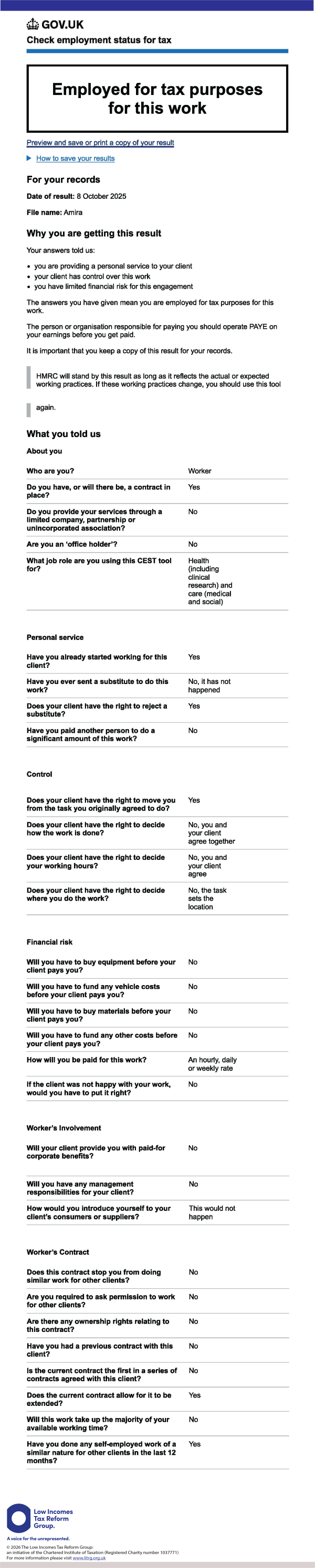
Here we provide a walkthrough of the CEST tool to help you understand the questions, based on the case study of Amira.
- Background
-
- Amira is a care worker providing social care support to elderly clients.
- She has been through a business start-up course to understand more about the care market and has invested in training such as health and safety, first aid and safeguarding. She paid for her own DBS check (Disclosure and Barring Service) and public liability insurance.
- Amira has recently been taken on by Mr Brown – a disabled person who has been given direct payments by the council to fund his own care and support.
- Engagement Details
-
- Amira gives Mr Brown a copy of her terms and conditions and explains the range of services and tasks that she is qualified, competent and insured to provide.
- She is not an office holder and doesn’t operate through a limited company.
- She starts work immediately after Mr Brown verbally agreed her terms and conditions, on a trial basis.
- Personal Service & Substitution
-
- Amira personally provides the care.
- Some of her care work for Mr Brown is, by nature, personal and relationship based. She would not be able to send someone else to do her work. If she is unable to attend, Mr Brown’s daughter can step in on an emergency basis or he can contact an agency.
- Control
-
- Mr Brown can ask her to switch care duties if priorities change but doesn’t direct every aspect of how her work is done.However there are also strict practices, safeguarding rules, and care plans to follow, which means she is under a framework of control.
- Her hours are agreed, not dictated – she can choose when to deliver visits, so long as needs are met. Some work must be done at his house, while other tasks (for example, walking his dog) can be done elsewhere.
- Financial Risk
-
- Amira provides some basic personal protective equipment and drives her family car to and from work. However, she doesn’t provide significant equipment, vehicles, or materials upfront.
- She is paid an hourly rate for care hours delivered.
- If Mr Brown was unhappy with her work, she would not be required to redo it at her own cost – she would simply stop being given hours.
- Worker’s Involvement
-
- She receives no staff benefits (for example, gym memberships, health insurance or retail discounts).
- She has no managerial responsibilities.
- She isn’t introduced to anyone as part of working for Mr Brown – her role is direct care delivery only.
- Contractual Factors
-
- She is free to work for other clients and does not need permission.
- Her current contract can be extended but is not guaranteed.
- This contract does not take up all her time, and she has taken on other care work in the past year on a self-employed basis (although it’s not clear if this was the correct status).
CEST tool determination
Based on these responses, HMRC would likely determine Amira ‘Employed for tax purposes’ – see the result below. This is because the nature of her working arrangement – personal service, degree of control, and limited financial risk – all point toward employment for tax purposes. This is even though Amira considers herself as self-employed in some of her other roles and her work for Mr Brown isn’t long-term or continuous, as yet.
As an employee, Amira should have pay as you earn (PAYE) operated on her wages by Mr Brown and should probably be given employment rights.
Helpline
HMRC have an employment status customer service team that may be able to help you work out if you are employed or self-employed or answer any questions you have about using the employment status tool.
When you speak to HMRC, be full and frank in explaining your working arrangements and the issues you face. Understand how far you can rely on their advice (as set out on GOV.UK) and follow the guidance in our getting help section – for example, take careful notes of the advice given, including the date, the adviser’s name (if available), and any reference number provided.