Digital platform reporting rules
Many people make a living from doing things in the gig economy like driving, delivering, or freelancing; often via online platforms such as Uber, Deliveroo and TaskRabbit. Some HMRC rules came into force in January 2024, these are known as the digital platform reporting rules or OECD rules. The OECD stands for the Organisation for Economic Co-operation and Development. On this page, we explain more about these rules and how they may affect people using online platforms.

Content on this page:
Digital reporting rules
Since 1 January 2024, digital platform reporting rules apply which require UK-based online platforms to:
- collect information about people who make money through their platforms over a calendar year, for example 1 January – 31 December, and
- on or before the following 31 January (i.e. 31 January 2026 for the period 1 January 2025 to 31 December 2025) - send this information to both HMRC and to the individuals themselves.
The information concerned largely relates to the identities of people and the money that they make through the particular platform. We explain who is affected by the rules under the heading How online platform users are impacted, below.
Once HMRC have this information from the online platforms, they can exchange it with other tax authorities in foreign countries who have also signed up to the new rules. This means these overseas tax authorities should be aware of money that people who live in their country are making from UK platforms (and vice versa).
These rules may make it easier for people who make money through online platforms to comply with their tax obligations as the platform operators must give them details of their earnings. This information may help them complete their tax returns for example. Our guidance on Seller information statements explains more about the information included on the statements. The information provided to HMRC about an individual’s earnings should help HMRC tackle non-compliance/tax evasion when individuals have not declared those earnings for tax purposes. However, there are some important points that people using these digital reports to complete their tax returns should be aware of and we explain more under the heading, Digital reporting and tax returns, below.
How online platform users are impacted
People who make money (including tips/gratuities and incentives) through the online platforms that are impacted by the rules will potentially have been affected since 1 January 2024. For the 2024 calendar year the digital platform reporting rules applied to people who joined the platforms within 2024. From 2025 onwards, these rules apply to all platform users.
The rules mean that if people have not been reporting their platform income properly and paying the appropriate tax, then HMRC are more likely to find out about it. The rules also mean that the online platforms might ask you more questions before they allow you to sign up or continue to use their platform to ensure they can collect the information about you that they are required to by HMRC. We explain more about this in our recent news article about Vinted asking for National Insurance numbers, which is linked to in ‘You might also like’ below.
The rules setting out which online platforms are impacted are very complex, however the key points are that:
- The new rules will apply to UK-based platforms that help make transactions between sellers of goods and services and customers possible (except those that do not allow sellers to make a profit from the payments received, e.g. some ride-sharing platforms where the only money that changes hands is a contribution towards fuel).
- If you use platforms in other locations – although these will not be required to report for the purposes of the UK reporting rules, they may be covered by similar rules in another country that is implementing the digital platform reporting rules. This means HMRC could eventually have the same information about transactions once the overseas tax authority has sent the information to them.
The following transactions are captured:
- Category A – those to do with property rental, vehicle rental or a personal service
- Category B – those to do with the sale of goods. These rules only apply to those selling goods if they make €2,000 (approximately £1,700) or more, or complete 30 or more transactions within a calendar year.
Category A captures things like taxi and private hire services, food delivery services, freelance work and the letting of short-term accommodation through online platforms. Category B captures people who buy or make purposefully to sell; but not those who sell a few personal belongings every now and again, for example to declutter.
Therefore people who make money via many different platforms, including the more well-known ones such as Uber, Deliveroo, Just Eat, Airbnb, TaskRabbit, Etsy and Ebay may all potentially be affected.
These rules will not affect all users of online platforms. However, it is still important to understand that even if your activity is not captured by the rules, you still need to check your tax position, as the money you are making could still be taxable. In particular the following types of people probably still need to do something about their taxes:
- if you fall within the ‘small’ Category B exemption (see above) but are still trading;
- if you are paid outside the platform for some element of your work, perhaps in cash or in kind or gifts (as explained on our Social media influencers webpage);
- if you have a business commercially selling direct to the public in fairs and boot sales as well as through a platform (for example, if you had an old antique coin business);
- if the online platform account you work under is not in your name, but a friend or relative’s (meaning HMRC will think the income belongs to them!)
Digital reporting rules and tax returns
In general, as explained on our gig economy webpage, most people have to declare their income from the gig economy to HMRC and pay tax on any profits they make. If you are already declaring your income, as required (see our flowchart below), then you don’t need to do anything differently. If you do not do this already, then you should take steps as soon as possible to bring your tax affairs up to date. Otherwise, you could have a problem when HMRC receive data that they realise does not match what you have told them or you have not told them about your income at all.
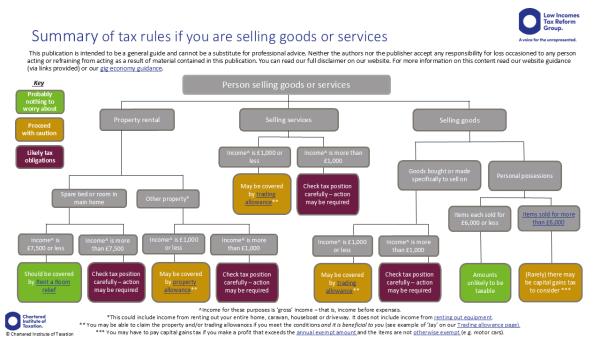
The flowchart below summarises the tax rules if selling goods or services.
Some considerations if you are selling goods
As can be seen in the flowchart there are two main exceptions to declaring income from selling goods:
- If you have total trading or miscellaneous income (before any expenses are deducted) of £1,000 or less (the trading allowance) and meet the other conditions for the trading allowance to apply; or
- If are selling personal items that you no longer want or to clear some space (this is unlikely to be counted as trading or miscellaneous income so does not use up the trading allowance).
When you are selling things you no longer want, such as books, toys, clothes etc., the reality is you are generally selling at less than you paid for them. Your activity is unlikely to be regular, organised or developed and you are not operating with a view to making a profit if you are simply trying to get back some of the money you originally spent on those items. You are therefore unlikely to be trading, so even if it is a significant amount, any money you make is generally not taxable. We explain in what circumstances you are likely to be trading on our gig economy page.
In rare instances, if you sell high value personal items like jewellery and paintings you may have to report and pay capital gains tax. Broadly this only applies if you sell the item for more than £6,000 and you make a profit. Even if you make a gain/profit, you may not have to pay any capital gains tax as you get an annual exempt amount (£3,000 in the 2025/26 and 2026/27 tax years). We explain more on our Selling shares and assets page.
Some considerations for those who are doing a bit of both selling goods and selling services
For those who are trading or generating miscellaneous income, there are lots of misconceptions – that because it is a side hustle, or you are paid in cash, or you have been doing it for less than a year then you don’t need to worry about telling HMRC – none of this is true.
Some people also think that if you have no tax or National Insurance to pay, then you don’t need to submit a tax return. HMRC say that if you have self-employment income of more than £1,000 you need to send HMRC a tax return, even if you believe there is no tax or National Insurance to pay. Read our guidance here for more information. It is important to stress that if HMRC have asked you to complete a return, by sending you a notice to file a tax return, you will still need to complete one in these circumstances – even if you have no tax or National Insurance liability – unless the notice is withdrawn or cancelled.
People who are doing a mixture of things (for example selling things to declutter and selling things they have bought or made specifically to sell on), may wish to try and manage the different strands of money separately to help keep themselves compliant. Using different online platforms is one way of doing this as it keeps everything neat and tidy. However, in reality, the UK tax system is a self assessment system, with the onus on you to factor in what needs to be reported. Provided you are keeping good records that clearly demonstrate the difference in the nature of the underlying items that are being sold and that explain inclusions and exclusions in your workings and reported figures – this should hopefully be enough.
We have more information on record keeping on our self-employment section. This page also covers what records you may want to keep if your income is below the trading allowance and you don’t actually need to complete a self assessment tax return.
What happens if HMRC use the data to check your tax position?
We look at failing to notify HMRC of the need to do a tax return or failing to file a tax return on time on our webpage, Gig work- what to do if you are behind on your taxes.
Furthermore, an excellent article we reproduce here, clearly sets out some of the traps of online selling and provides some hugely useful information on how to handle an HMRC enquiry.
This article was first published in Tax Weekly and Business & Accountancy Daily by Croner-i. The original article can be found here. Bash Khanzada, author of the article, is part of Croner-i’s VIP Tax Team who help people with HMRC enquiries.
The issues raised are highly relevant to any unrepresented taxpayers who are making money through online platforms. With kind permission of Croner-i, we are able to reproduce the article here and make Bash’s very valuable insights available to those who can’t access the original.
- HMRC backs down on £60k eBay trading enquiry
-
Casual online selling can lead to an unwanted HMRC intervention over taxable trade, warns Bash Khanzada, consultant at Croner-i VIP Tax Team
In today’s digital economy, individuals increasingly use online platforms such as eBay, Vinted and Depop to supplement their income. What often starts as a hobby or a means of clearing out unwanted items can evolve, sometimes unintentionally, into an activity HMRC deems to be a taxable trade.
Once certain thresholds are met, taxpayers may find themselves the subject of an HMRC enquiry, sometimes many years after the activity began.
In a recent case, we were instructed to assist an individual facing such an enquiry. The matter involved historical trading activity on eBay, and at stake was a liability in excess of £60,000, which consisted of unpaid tax, interest and penalties over multiple years.
With careful negotiation, strategic representations, and a deep understanding of HMRC’s compliance approach, we were able to reduce that liability to approximately £9,000.
This article explores how Croner-I VIP Tax Team achieved that result and what lessons can be drawn for other taxpayers engaged in similar online activity.
- Gradual shift from casual selling to trading
-
Our client had always held full-time employment and initially began selling items on eBay as a way to earn some extra income. The activity began many years ago and started off on a very small scale, comprising mostly of low value, occasional sales of personal belongings and second-hand goods.
Over time however, the scale and frequency of the sales increased. What was once a casual hobby developed organically into a side income stream. They began to source goods specifically for resale and opened more than one eBay account.
The increase in volume brought the activity within the realm of what HMRC considered to be a taxable trade.
Using data obtained directly from eBay, HMRC opened an enquiry and reviewed the client’s activities over several years.
HMRC identified characteristics associated with trading, commonly referred to as the ‘badges of trade’. These included the frequency of transactions, intention to make a profit, and organised buying and selling.
As a result, HMRC concluded that the individual had failed to notify HMRC of their trading activity and had submitted inaccurate returns (or failed to submit returns at all) in the relevant years.
- HMRC’s position
-
HMRC initially took a firm and uncompromising stance. They concluded that the behaviour had been ‘deliberate’ based on the following arguments:
- The individual had agreed to eBay’s terms and conditions, which clearly mention the user’s responsibility to comply with applicable tax laws.
- Multiple eBay accounts had been used, which HMRC alleged was an attempt to evade VAT registration as turnover approached the threshold.
- There was no attempt to notify HMRC or file returns in the relevant years despite the income generated.
- Challenges with record-keeping
-
One of the most difficult aspects of the case stemmed from poor record-keeping. Separate bank accounts for personal and business finances had not been maintained. Instead, a single bank account was used for all transactions, both personal and eBay related.
This presented a significant evidential challenge. HMRC’s initial position was that, in the absence of clear records, they would disallow all expense claims, thereby increasing the taxable profit considerably.
We objected to this approach and took the position that, in a trading scenario involving physical goods, it was unreasonable to suggest that the business had no costs of acquisition.
A sample-based review of the bank statements was undertaken to identify likely business related purchases and patterns in spending.
From this, we negotiated with HMRC to accept a reasonable percentage-based deduction for acquisition costs and other relevant expenses, even in the absence of perfect records.
Additionally, a forensic review of the sales and transaction data identified several transactions that were not related to trade. These included personal belongings and one-off disposals.
Evidence was presented to show that these sales should not be treated as trading income, further reducing the client’s exposure.
- A turning point – face-to-face meeting with HMRC
-
Recognising the complexity and sensitive nature of the case, a face-to-face meeting was requested with HMRC, which was granted. The meeting was attended by us and our client, and it provided a valuable opportunity to present the human side of the story, as well as to address factual and technical issues directly.
At the meeting, the following representations were made:
- The client had no formal education in taxation and did not appreciate the difference between casual sales and taxable trading.
- They believed eBay deducted tax at source, due to platform fees being regularly applied to transactions.
- The use of multiple accounts was not a deliberate attempt to avoid VAT, but rather a product of limited technical understanding and occasional account restrictions.
- At various points during the relevant periods, they experienced serious family difficulties that significantly impaired their ability to manage financial affairs.
- They had even filed self-assessment returns in some of the earlier years, albeit for unrelated income, suggesting there was no conscious effort to hide from HMRC.
- Outcome
-
HMRC ultimately revised their position significantly. Specifically:
- The inaccuracy penalties were downgraded from ‘deliberate’ to ‘careless’, with maximum reduction applied.
- The failure to notify was accepted to be ‘non-deliberate’, again with maximum reduction.
- The final liability, taking into account the amount of unpaid tax, interest and reduced penalties, was reduced to approximately £9,000. This was a significant reduction from the original £60,000 figure.
- Key lessons
-
This case serves as a powerful example of how online activity can unintentionally drift into taxable trading, and how failing to address tax compliance early can lead to significant consequences.
However, it also demonstrates that with professional representation and a full understanding of HMRC’s penalty framework, it is often possible to arrive at a fair and reasonable resolution, even in the face of serious initial allegations.
- Key takeaways:
-
- Mixed-use bank accounts can cause serious evidential problems. Keeping separate personal and business accounts is strongly recommended.
- HMRC enquiries can be negotiated, especially where there is clear evidence of misunderstanding or mitigating personal circumstances.
- Deliberate behaviour is a serious allegation, but not always justified. Proper legal and factual analysis can often reframe the issue.
- Platform terms and conditions (such as those on eBay) are increasingly used by HMRC as evidence that taxpayers were ‘on notice’ of their tax obligations.
- Face-to-face meetings with HMRC, where appropriate, can be a highly effective tool in softening entrenched positions and achieving positive outcomes.
- Conclusion
-
As HMRC continues to increase its focus on online sellers and digital platforms, more taxpayers are likely to find themselves subject to enquiries like this one. For anyone facing scrutiny over eBay or any similar online trading platform, it is vital to act quickly, gather relevant evidence and engage skilled representation.
More information
The rules implement the OECD’s “Model Rules for Reporting by Platform Operators with respect to Sellers in the Sharing and Gig Economy”.
GOV.UK contains guidance on what details you need to give to digital platforms as part of the digital platform reporting rules. HMRC’s supporting technical guidance explaining the scope/definitions etc. of the rules can be found on GOV.UK.